

There are roughly six million EVs on U.S. roads. About one million can already move electricity in both directions.
At roughly 10 kW per vehicle, that puts the theoretical export capacity close to 10 GW.
That sounds enormous. It is also a little misleading if you stop there.
A million cars do not behave like a power plant. Some won’t be home when the grid peaks. During a long outage, the owner may need to drive. Most aren’t connected to a utility program that can call on the battery anyway.
Still, 10 GW is hard to ignore. It’s roughly the output of nine Vogtle-sized reactor units, except the batteries have already been purchased and are sitting in garages and driveways.
That’s where I started digging.
Why I Started Looking at This
We live in a condo complex in Westchester, New York. The power lines inside the development are underground, but they are fed by overhead lines outside it, and we lose power more often than we would like.
I sit on the HOA board, so I see the applications for whole-home gas generators. They work if you have an end unit. We don’t. We looked at home batteries too, but with a single-car garage, there isn’t much room to give up.
What we do have is a Tesla Model Y.
Our Model Y can’t currently power the house. Tesla hasn’t enabled vehicle-to-home charging on it, although there are signs the underlying hardware may be capable of it. Other EVs can already do this.
So we started looking for a big battery that could keep the house running when the power goes out.
Ideally, one we could drive and still like as a vehicle.
The Promise: Cars as Grid Assets
That introduced me to a whole collection of acronyms.
V2L, or vehicle-to-load, lets you plug appliances or equipment into the car. Useful, but fairly limited.
V2H, vehicle-to-home, is what interests us. With the right equipment, the car can supply the house during an outage.
Then there is V2G, vehicle-to-grid. In that case, the battery can send power beyond the house and back to the grid.
That was the part I hadn’t really thought about before.
Utilities are looking for new capacity for data centers, AI and other load growth. Meanwhile, millions of fairly large batteries are being bought by consumers and spending most of their time parked.
I wanted to know how much of that capacity could really be useful.
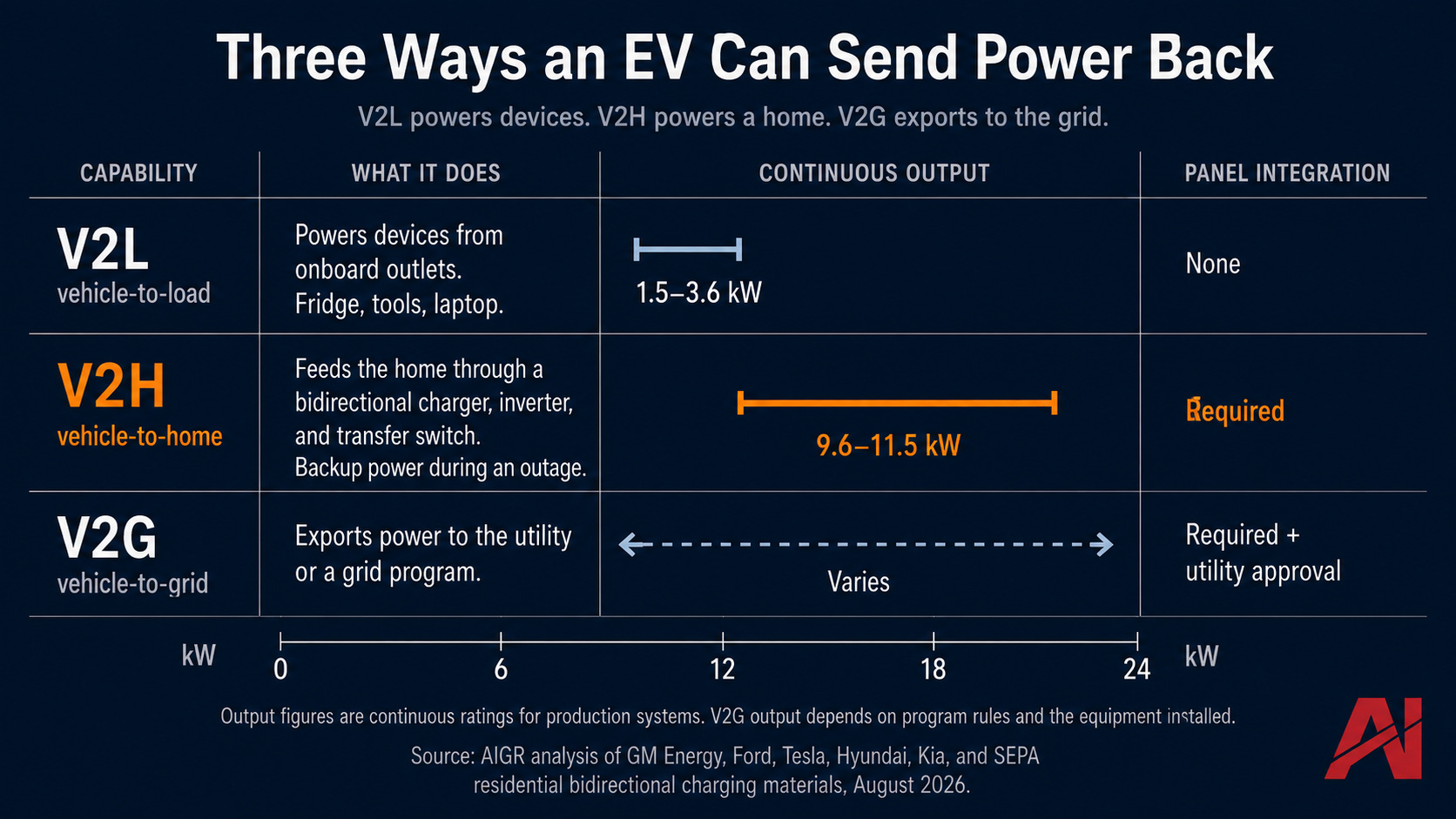
Only V2G turns the car into a grid resource.
The 10 GW estimate is the attention-grabbing number. The useful number is smaller.
To get from one to the other, you have to look at when the cars are actually available, what it costs to connect them, how repeated cycling affects the battery, and whether utilities can call on that power and pay for it.
I also wanted to see where V2G is already working. There are a few real programs with actual vehicles and actual compensation, and they tell us quite a bit about what it would take to scale this.
That’s what I looked at next.
Subscribe to keep reading.
