

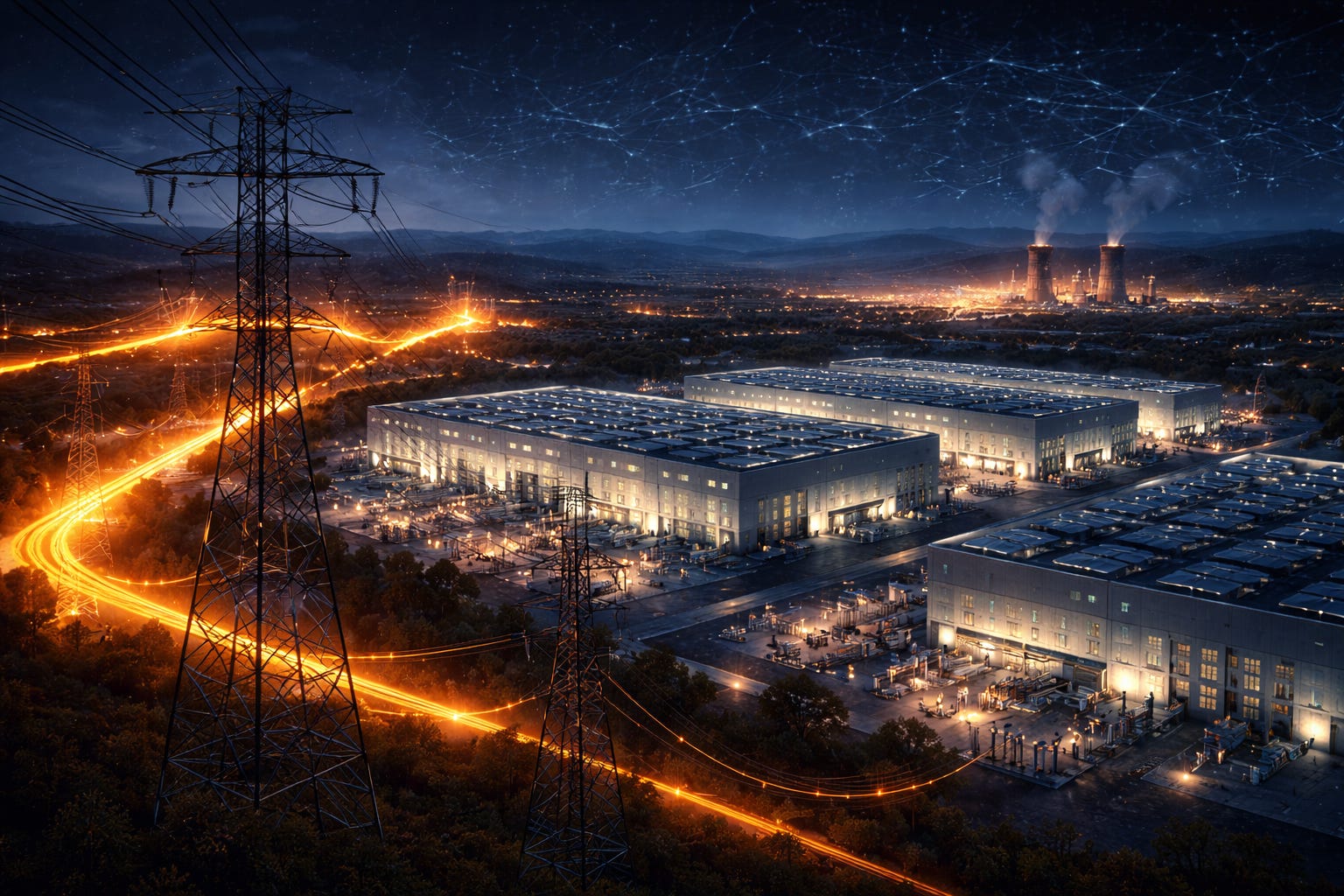
Everyone is talking about AI.
The models.
The startups.
The trillion-dollar race to build the future.
But most people are looking in the wrong place.
Because the real constraint on AI isn’t software.
It’s the power grid.
AI is being treated like a software revolution.
Something you scale with better code, bigger models, and more investment.
But AI isn’t just software.
It is one of the most energy-intensive technologies ever deployed at global scale.
And the infrastructure required to power it — power plants, transmission lines, substations, and data centers — moves far more slowly than the technology itself.
In other words, the future of AI may not be determined by algorithms.
It may be determined by electricity.
The AI Economy Runs on Electricity
Artificial intelligence ultimately runs on physical infrastructure.
Applications depend on models.
Models depend on compute.
Compute depends on data centers.
Data centers depend on electricity.
Remove electricity from that chain and the entire AI economy stops.
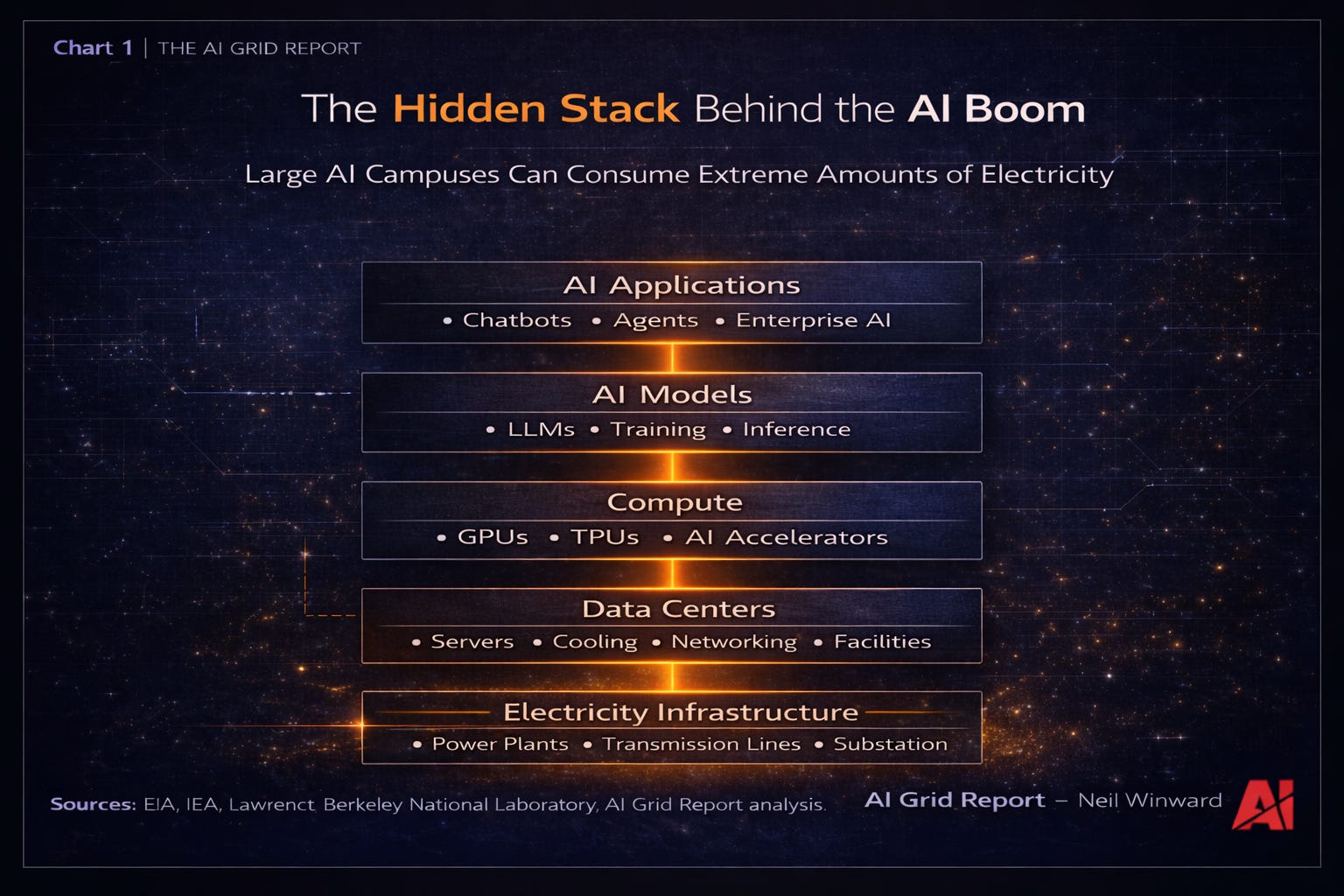
This framework illustrates the full stack of the AI economy — and why electricity sits at the bottom of everything.
The Coming Electricity Shock
For most of the past two decades, electricity demand in developed economies barely grew.
Efficiency improvements offset new consumption.
LED lighting replaced incandescent bulbs.
Computers became more efficient.
Manufacturing moved overseas.
Utilities built their systems around this assumption.
Demand would remain relatively stable.
But AI is breaking that trend.
Training and running large AI models requires enormous amounts of computing power.
And computing power consumes electricity.
Lots of it.
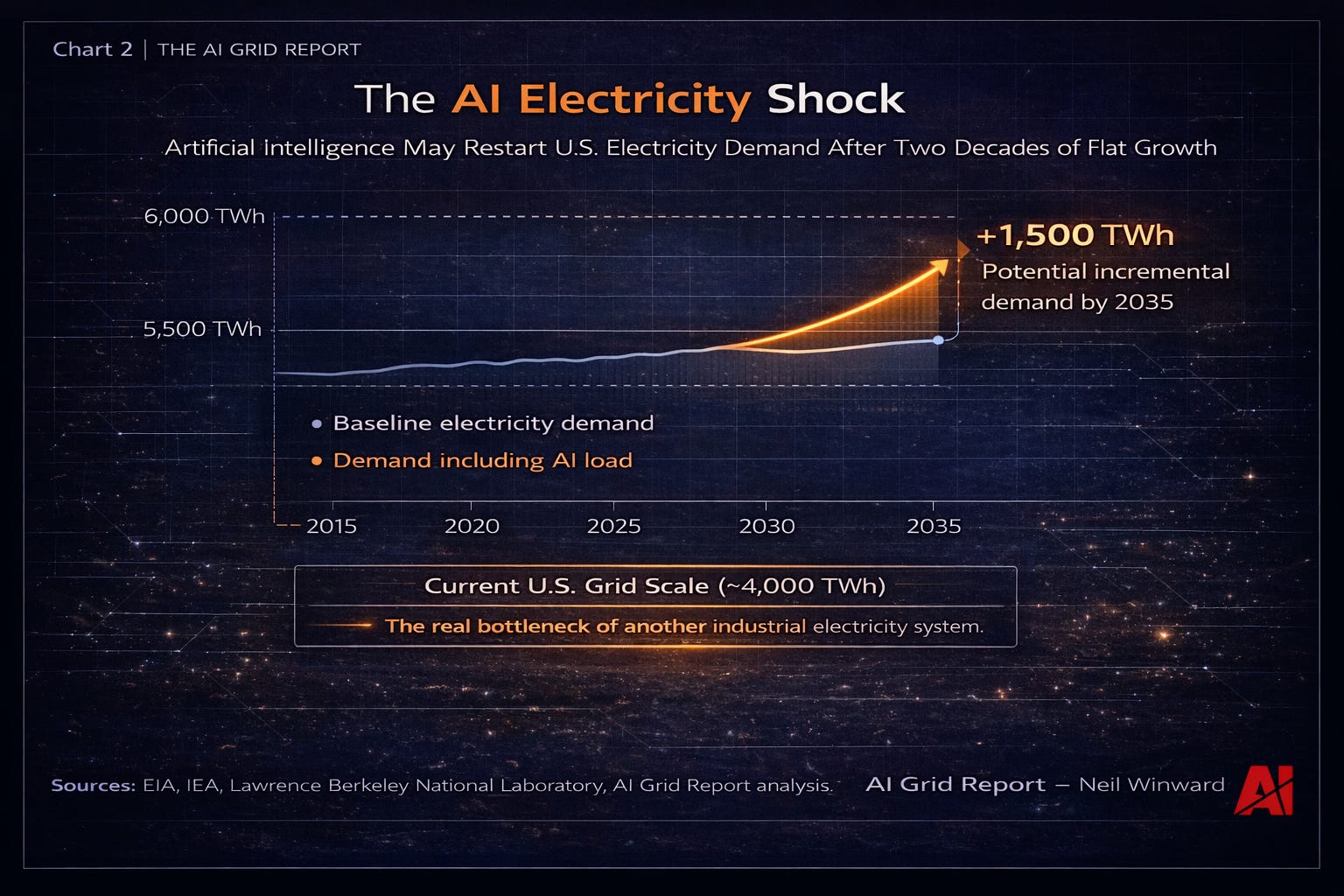
This chart illustrates how AI could restart electricity demand growth after decades of stagnation.
If large-scale AI adoption continues, the electrical grid may face the largest new demand expansion in a generation.
The Power of One Data Center
Most people still underestimate how much electricity modern AI infrastructure consumes.
Large hyperscale AI campuses can require extraordinary amounts of power.
Not megawatts.
Hundreds of megawatts.
Sometimes even gigawatts.
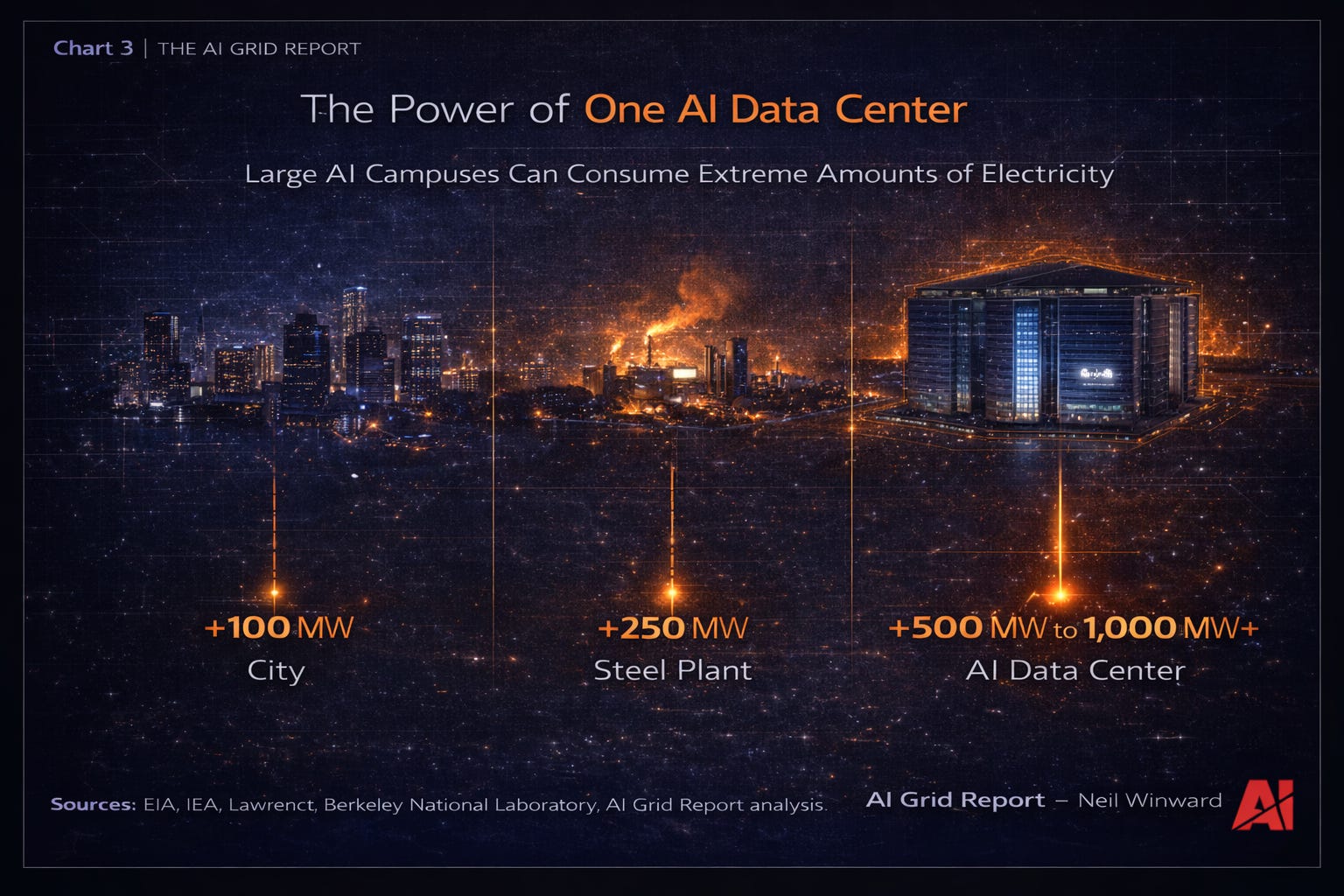
This comparison shows that a single AI data center campus can consume as much electricity as a small city.
In some cases, it approaches the power consumption of major industrial facilities.
Which raises an uncomfortable question.
How many of these facilities will the grid actually be able to support?
The End of the Flat Electricity Era
For most of the past twenty years, electricity demand remained relatively flat in developed economies.
Utilities planned their infrastructure around that stability.
But AI changes the equation.
If AI adoption accelerates, electricity demand could begin rising again — potentially faster than the power system was designed to handle.
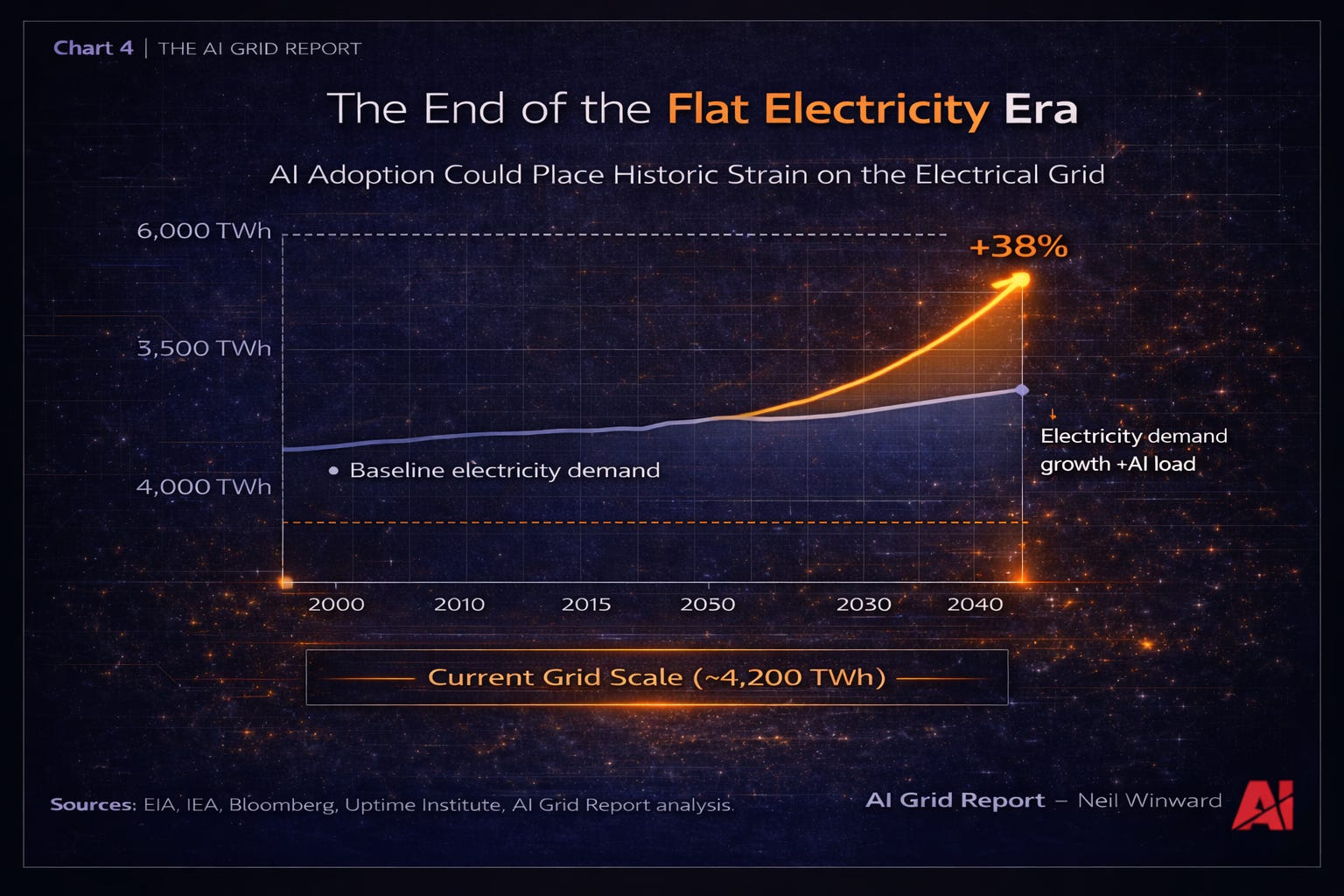
This chart shows how AI could become one of the largest new drivers of electricity demand in decades.
The implications extend far beyond technology companies.
They affect the entire global energy system.
The Physical Limits of AI
Building software is fast.
Building infrastructure is slow.
Training a new AI model can take months.
Building a new power plant can take years.
Building new transmission infrastructure can take a decade or more.
Permitting processes alone can take longer than the development cycle of most startups.
And data centers themselves face additional constraints:
• available land
• access to water for cooling
• grid interconnection capacity
• local permitting and political approval
Scaling AI is not just a technological challenge.
It is an industrial challenge.
Where AI Data Centers Will Be Built
If electricity becomes the bottleneck for AI, the geography of the AI economy may change.
The most important locations may not be where the best engineers live.
They may be where the most electricity is available.
Chart 5 — Where AI Data Centers Will Be Built
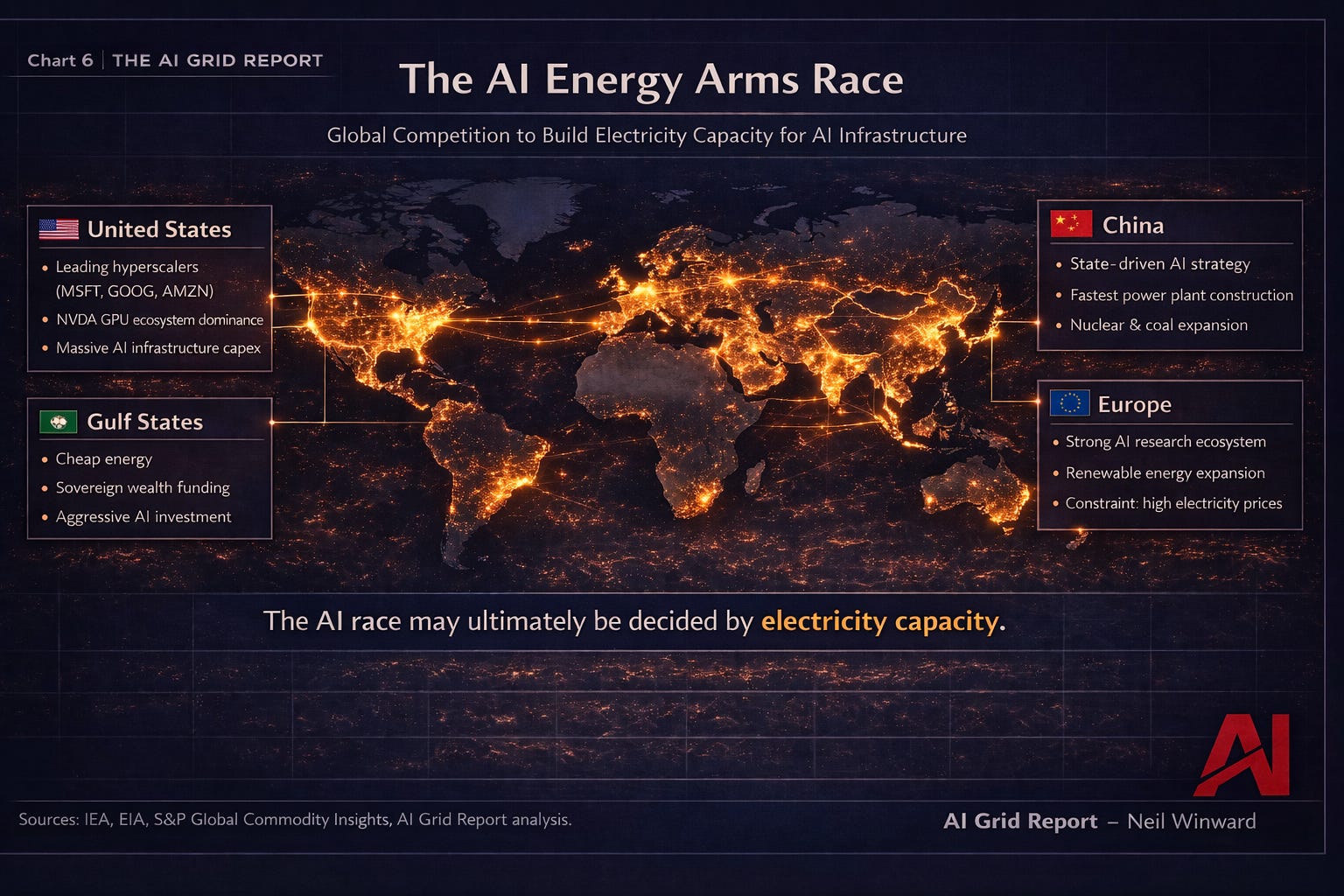
This chart highlights regions with favorable conditions for large-scale AI infrastructure.
Electricity availability may become one of the primary factors determining where AI infrastructure is deployed.
The Largest Electricity Machine Ever Built?
If AI adoption continues accelerating, humanity may be building one of the most electricity-intensive systems ever created.
Every major industrial system runs on energy.
Manufacturing.
Transportation.
Heavy industry.
The global internet.
AI could soon join that list.
And unlike many previous technologies, AI scales directly with computing power.
More models.
More inference.
More data centers.
More electricity.
The world has never built a digital system that requires this much continuous power.
Yet most of the AI conversation still focuses on software.
Very few people are asking the infrastructure question.
Can the grid keep up?
Why We Created AI Grid Report
This is exactly why we launched our publication, The AI Grid Report.
To track the intersection of:
• artificial intelligence
• electricity infrastructure
• energy markets
• geopolitics
• and the global race to power the AI economy
Because the future of AI will not be determined only by software.
It will also be determined by the physical systems that power it.
Final Thought
AI may reshape the global economy.
But before it can do that…
it has to plug into the grid.
And the grid wasn’t built for what’s coming.
Subscribe to The AI Grid Report
If you want to understand the energy infrastructure behind the AI revolution, subscribe to AI Grid Report.
We’ll be mapping the system that will determine how fast the AI future actually arrives.