

Standing disclosure. I hold positions in some of the securities named below. They are listed at the top of this edition without sizes. Nothing here is investment advice, a recommendation, or an offer. This publication is impersonal, produced on a regular schedule, and offered to the general public. I receive no compensation from any company, fund, or service named in this edition.
Positions held among the names in this edition: SMH (VanEck Semiconductor ETF). Bloom Energy, entry $274, stop at $228.
Edition 24 sorted twelve “AI power” names by distance from the interconnection constraint and found four with grid revenue.
Three of them are paid when a project reaches the grid. One is paid when it stops trying.
This edition is about that one.
The case for Bloom Energy is a case about time. A data center that can’t connect to the grid within its build schedule has two choices: wait or generate on-site.
Bloom sells the second. What follows tests whether the fast-pass thesis holds up against the numbers, the physics, the competitors, the permits, and the price.
It survives most of them. Not all of them.
How much load is waiting
Start with queue size, because Bloom offers a fast pass to people who loathe waiting.
In ERCOT (the grid operator covering most of Texas), by July 2026, when its new Batch Zero process went live, the load requests stood at 498 gigawatts, more than five times the record peak Texas set that month, 91.1 gigawatts, per the Energy Information Administration.
Most of the queue was speculative, and Batch Zero, ERCOT’s first batched study of large loads of 75 megawatts or more, put a number on how much.
Its eligibility screen, presented to the Senate Committee on Business and Commerce on 29 July, passed 204 gigawatts across 326 projects and kicked out 294 gigawatts across 362.
The generation side is worse. Lawrence Berkeley National Laboratory’s count of generation and storage waiting for a grid connection across the United States stood at about 2.3 terawatts at the end of 2024, 1.4 terawatts of generation and 0.9 of storage, in its 2025 Queued Up report.
The projects that would serve the new load face the same problem.
Eaton, which sells the switchgear and transformers that sit between the two, told analysts on its second-quarter call that its estimate of the US data center backlog had reached 307 gigawatts, fifteen years of construction at the 2025 build rate, and that only about a fifth of it will convert near term.
GE Vernova (one of the twelve names covered last week), which sells the turbines that would generate for that load from the grid side, reported 116 gigawatts of gas equipment under contract or reserved at the end of June compared with 20 gigawatts of annual output. Fifty-three of those gigawatts are firm orders. Sixty-three are slot reservations, which are customers paying to hold a place in a different queue: the factory’s.
So, the constraint isn’t one queue.
It is three.
The grid queue, the generation queue and the turbine queue, and a campus that wants power in 2027 is at the back of all three lines.
The route around
Behind-the-meter generation (also called islanded power, built on-site, wired to the load, with no grid connection needed for normal operation) is the route around all three. It has moved from a backup plan to a default option in eighteen months.
Cleanview, which tracks the projects from permits, filings and satellite imagery, counted about 90 gigawatts of behind-the-meter generation announced or planned across 59 data centers by mid-2026. About 2 gigawatts are operating. About 36% is permitted. The rest is announcements.
More than a quarter of all planned US data center capacity now comes with its own generation.
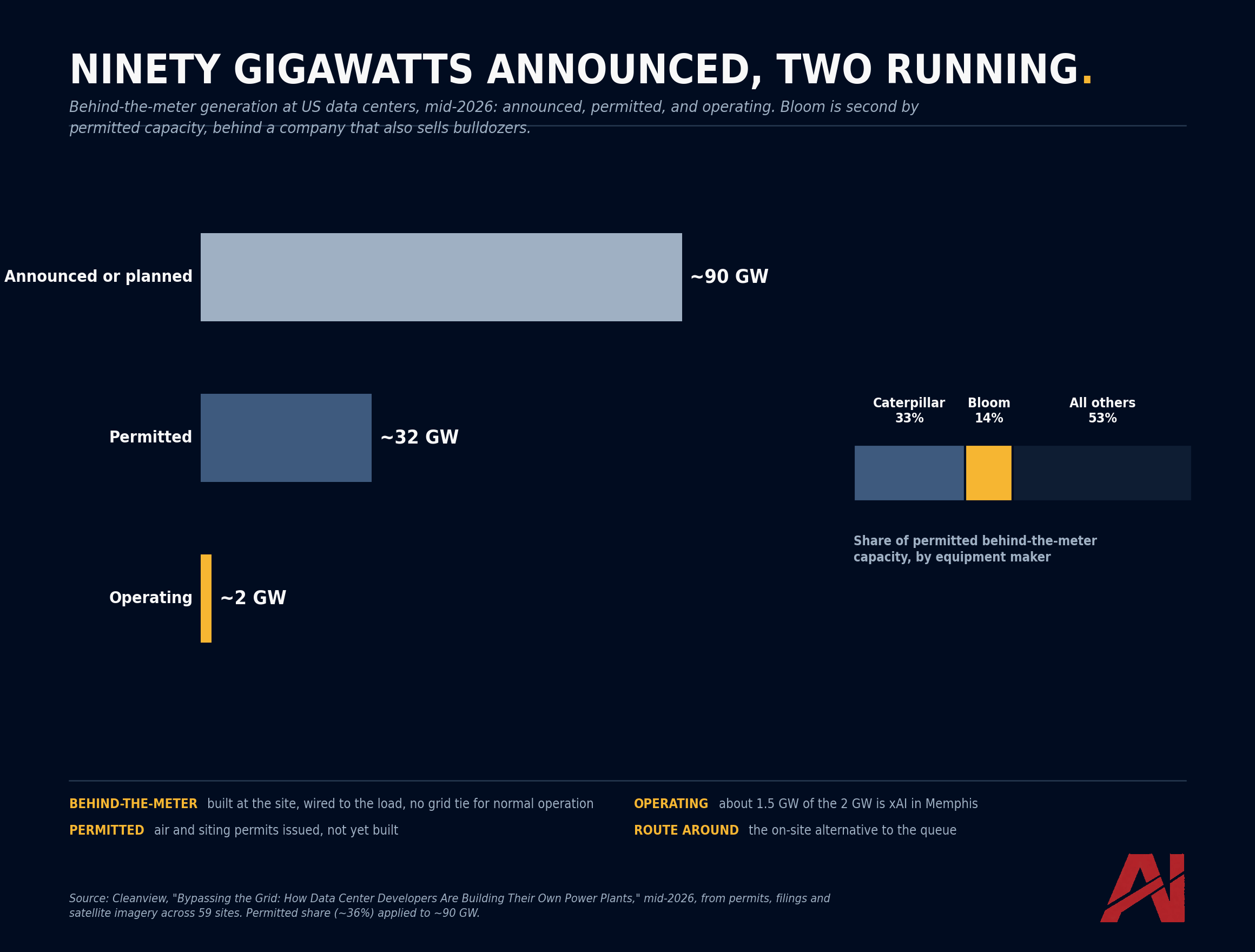
Chart 1 — Ninety gigawatts announced, two running. Behind-the-meter generation at US data centers, mid-2026, and the share of permitted capacity by equipment maker. Source: Cleanview.
That 90 gigawatts is Bloom’s market. The fuel is almost all natural gas. Most of the machines are Caterpillar’s reciprocating engines and GE Vernova’s turbines, the same turbines that are sold out on the grid side. By Cleanview’s count, Caterpillar holds about a third of the permitted behind-the-meter capacity and Bloom about 14%.
Bloom is the second-largest supplier on the route, behind a company that also sells bulldozers.
The premise that needs testing
People who oppose a data center will oppose a data center with a power plant attached to it even more.
Gallup found that 71% of Americans opposed an AI data center near them in March, compared with 53% opposed to a nuclear plant. Marquette Law School’s Wisconsin poll moved from 55% to 78% saying data centers’ costs outweigh their benefits between October and August.
Inside Climate News counted at least fourteen candidates running against data centers who beat candidates running for them in Michigan’s August primaries.
Add gas turbines, fuel trucks and a stack to the campus, and the hearing becomes harder.
If that premise holds, then the on-site generator that burns the least, makes the least noise and asks for the least water wins the hearing that the turbine loses. That is Bloom’s pitch.
Oracle’s Project Jupiter in New Mexico swapped its planned turbines for up to 2.45 gigawatts of Bloom cells in April, and the joint announcement claimed a 92% reduction in NOx against the turbine design.
Then the New Mexico State Land Office refused the pipeline that would fuel it.
The Commissioner’s letter of 14 July says the project, “even after the switch from gas-fired plants to fuel cells,” is expected to emit more than 10 million tons of greenhouse gases a year by its own permit applications, and that “advancing the massive use of gas for a project of this scale is simply not in the best interest of the trust.”
The fuel cell swap improved the air permit and the water story. It didn’t change the fuel, and the fuel is what the state refused.
So the premise holds, and it cuts the other way too. Emissions-light is lighter than the turbine. It wasn’t light enough for the office that controlled the right-of-way.
That is the finding the paid section is built around. Bloom is the best-placed public company on the route around the grid, and the route isn’t free.
In the full edition: how a solid oxide fuel cell works and why its output speaks the data center’s native language.
What Bloom’s filings say it sells, to whom, and what the revenue is worth once the Oracle warrant passes through it.
The Jupiter record, from a 0.6-mile right-of-way to a February 2027 in-service date. The competitors, and why the nearest one is a bulldozer company. The stock, the price path, and what a 13.5 times next-twelve-month sales multiple requires. The scandium question, unresolved. And how I own it, with the sleeve and the stop worked through in public.
None of it is investment advice.
The rest of this is for paid subscribers - free subscribers can read it on a no obligation 30-day trial, open until 21st September, the day Bloom Energy enters the S&P 500!
