

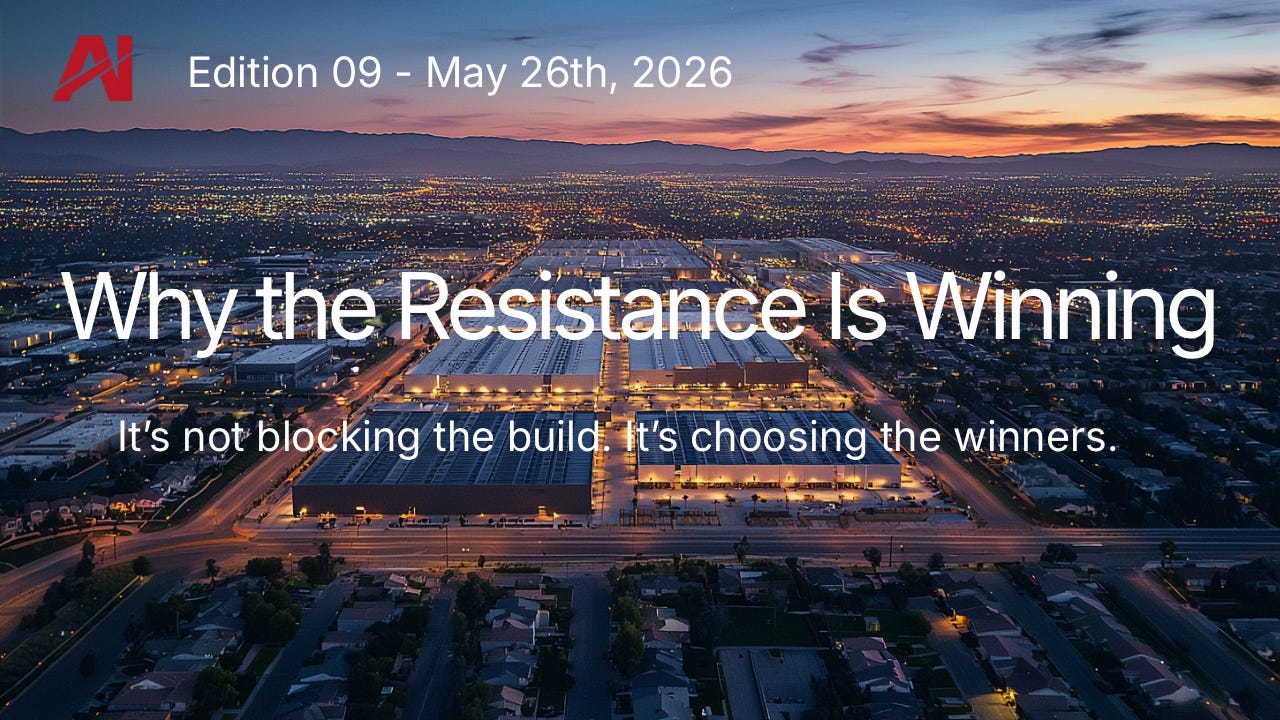
The Fight That Everyone Wants to Have
Local rejections of US data-center projects totaled 49 across all of 2025.
The first five months of 2026 produced 89. Twenty projects were canceled in Q1 alone — more than $41.7 billion in planned investment shelved.
The political revolt against data centers is no longer a Northern Virginia curiosity.
It is a national pattern with a measurable slope, and the slope is the story: the rate of refusal is now rising faster than the rate of construction.
That one fact changes how you read every headline about AI infrastructure spending.
US data-center capacity has grown at 24% annually since 2020. The average facility coming online in 2025 was 80 MW — three times the size of five years ago. The latest campuses are sizing to 1 GW and beyond. Virginia alone hosts 665 facilities. Its data centers consumed roughly 40% of the state’s electricity in 2024. Northern Virginia’s “Data Center Alley” accounts for an estimated 14% of all data centers worldwide.
That concentration is the mechanism behind the backlash now taking shape.
This is the constraint this issue examines — not whether the buildout happens, but which version of it survives contact with the communities it lands in.
Below the paywall:
• who is right on jobs and water — and why both sides can cite real numbers
• why electricity-rate fights become political fast
• what the financing structure says about long-duration AI capex
• and why the projects facing the least political resistance may end up shaping the build
The resistance is not stopping the build.
It is increasingly deciding what gets built — and where.
Subscribe to continue reading.
