

Standing disclosure. I hold positions in some of the securities named below. They are listed at the top of this edition without sizes. Nothing here is investment advice, a recommendation, or an offer. This publication is impersonal, produced on a regular schedule, and offered to the general public. I receive no compensation from any company, fund, or service named in this edition.
Positions held among the names in this edition: SMH (VanEck Semiconductor ETF). Of the four grid names in the paid section, I hold none today and expect to own one or more soon. The section on what I own says which.
For twenty-three editions, this report has focused on the grid’s capacity to absorb new load. I have scored and published queue depths, withdrawal rates, and wait times. I have spent a lot of time on data centers, because they are the load that is filling the queues.
Measurement, though, is only half the picture. At some point, research has to steer investing, or it’s just a hobby. This is not a hobby.
This edition makes that pivot.
The map everyone draws
Every publication organizes AI power investing by how hard something is to buy: stocks, then ETFs, then private companies.
That says nothing about the assets.
This edition orders twelve widely-held “AI power” names by distance from the constraint instead, meaning how much revenue is gated by whether and when interconnection happens.
They form three camps, and each camp is different.
The three camps
Camp A — revenue arrives when the interconnection queue clears. Three names. Switchgear, substations, transformers, turbines, and the power and thermal equipment inside the data hall. Their order books fill as projects approach energization.
Camp B — exposed to AI capital spending, not to grid constraints. NVIDIA, TSMC, Micron, Marvell, KLA, Monolithic Power, Lumentum, Corning. Eight of the twelve. They sell into the AI buildout. Their revenue is driven by capex budgets, foundry capacity, and product cycles.
Camp C — revenue arrives when the queue fails. One public name carries this camp, because it’s investable and liquid: on-site generation, sold explicitly as the route around interconnection delay. Behind it sit two private companies.
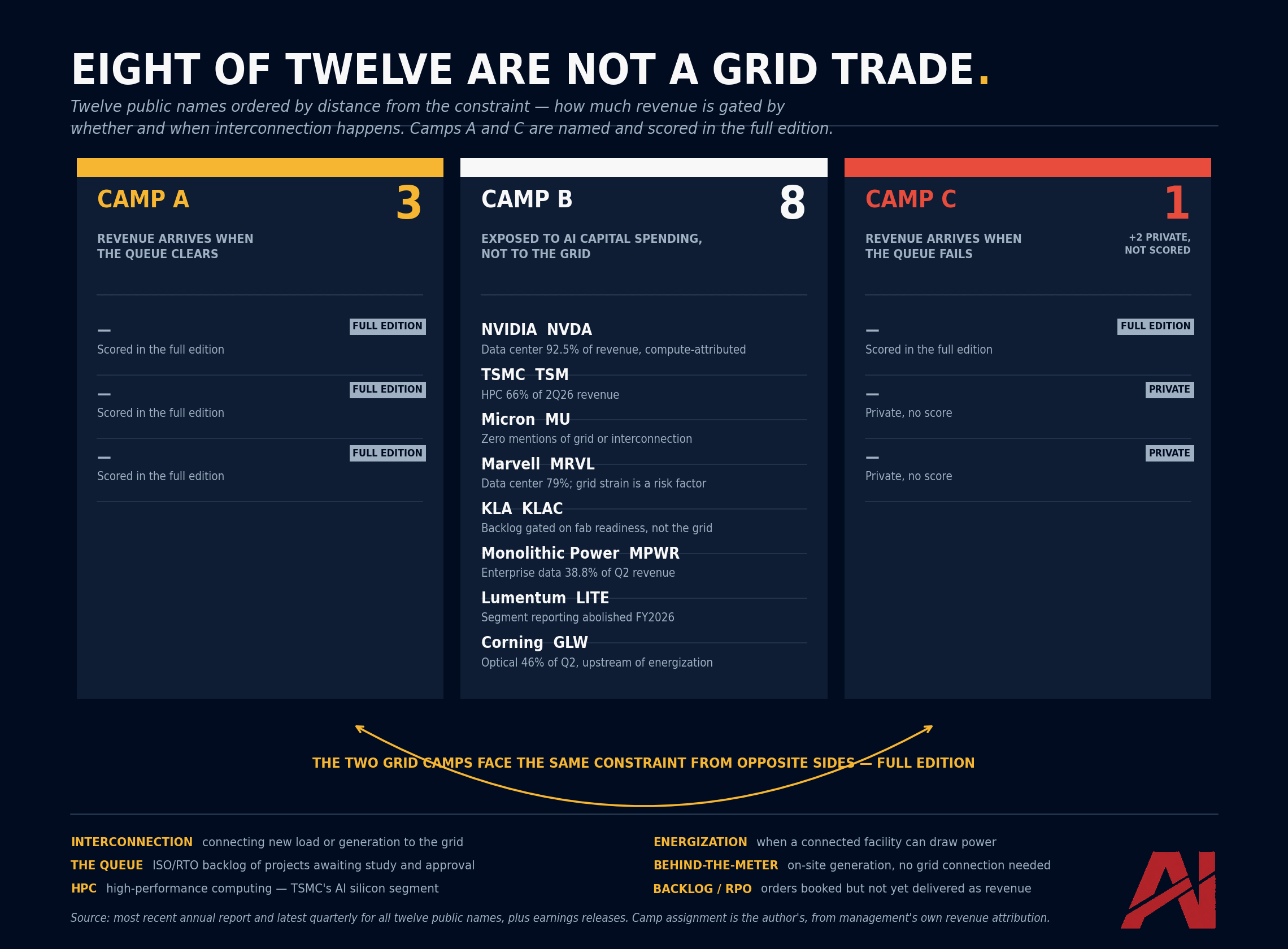
Chart 1 — The camp map. Twelve public names ordered by distance from the constraint. Camp B in full; Camps A and C are named and scored in the full edition. Camp assignment is the author’s, based on each company’s revenue attribution in its most recent annual report and latest quarterly.
The classification
Most of the names you can invest in as an “AI power” position are not a grid position at all.
I checked them out by reading the filings instead of the coverage - the most recent annual report and latest quarterly for all twelve public names, plus the earnings releases - and management’s view on revenue attribution.
Across eight Camp B names, none of the filings attribute material revenue to grid or utility infrastructure demand.
NVIDIA’s data center platform was 92.5% of last quarter’s revenue, and it attributes every dollar to compute demand.
Marvell runs at 79% data center revenue on AI bookings.
KLA credits a backlog that grew from $7.86 billion to $12.57 billion in a year to “strong demand driven by the AI infrastructure buildout” — semiconductor fab tools, one full derivative removed from any substation.
Micron is the starkest. Search its annual report and latest quarterly report- more than 600,000 characters of disclosure - for interconnection, energization, power availability, or the grid, and the count is zero. Not even a passing mention.
These are good businesses in a very good year. But they aren’t really a grid trade.
Where the grid impacts them, it hurts.
A data center that can’t energize defers a silicon order. NVIDIA now says so in its own risk factors, warning that customers “may delay adopting new architectures if their data center infrastructure is not ready,” and it has put $105 billion of guarantees behind a single Ohio campus whose revenue phasing depends on those buildings becoming ready for service.
Marvell added the same theme to its risk factors in August, naming power procurement constraints and strain on local energy grids as things that could slow the deployments its revenue depends on. That language doesn’t appear anywhere in the annual report it filed in March.
The constraint is beginning to appear in Camp B’s filings as a risk, not a source of revenue.
The other four
That leaves four names attached to grid revenue. They split into two camps, each with the same constraint from opposite sides. What surprised me is that they earn revenue in very different ways.
That contrast is the position. Held one way, it’s two grid-themed investments. Held another way, it’s a position on the buildout with a tilt on timing. The full edition sets out which is which, and what would change the answer.
In the full edition: the position and how the two sides of it balance. The observable events that should move the balance. I’ll give you a heads-up before they happen. The four names, one at a time, with the confidence I have in each and what might dilute that confidence.
An ETF look-through for those of you more comfortable with ETFs than with direct, single-name investments, including which “AI power infrastructure” fund is a renamed oil fund, which one added crypto miners to its mandate in January, why the fund with the most accurate name may not give you what you’re looking for, and where Camp C exposure sits, in the wrappers you would not look in first.
What I own, what I sold, what I am still looking at, and where my own process disagrees with my own research. The private rung, with a candid look at access. And the conditions under which every claim in this edition would be wrong.
None of it is investment advice.
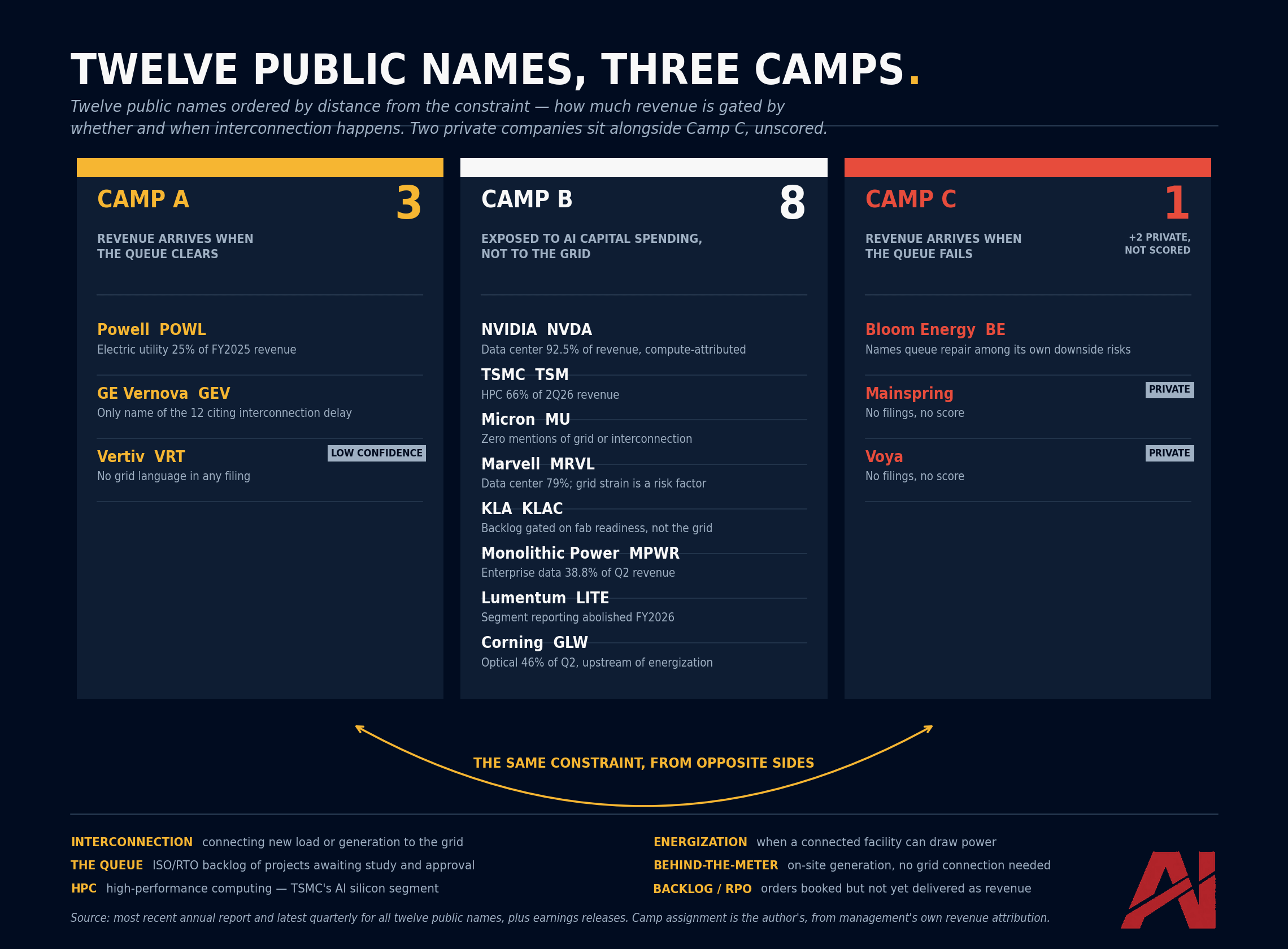
Chart 1, in full — The camp map with all twelve names. Camp assignment is the author’s, based on each company’s revenue attribution in its most recent annual report and latest quarterly.
What this chart resolved into
Four names, two camps.
The A side — GE Vernova, Powell, Vertiv
The equipment a project needs to reach energization, sold to utilities on the grid side and to campuses on the load side.
The C side — Bloom Energy
On-site fuel cells, sold as the route around the queue. Behind Bloom sit two private companies, Mainspring Energy and Voya Energy. Neither files with the SEC, so neither is scored here.
How the two sides balance
The investment doesn’t depend on whether the queue resolves. It depends on whether the buildout proceeds.
If interconnection timelines improve, Camp A’s order flow persists, and Bloom matters less. If they degrade, Bloom’s market widens, and Camp A’s backlog converts more slowly. Either way, one side is paid. What neither side survives is the buildout stopping.
Local opposition doesn’t stop it. Voters constrain the next wave of applications, not the campuses that have already passed zoning, signed tariffs, and posted collateral.
Those campuses still need substations, switchgear, transformers, and turbines, and that is the backlog Camp A is working through now. What the opposition threatens is the order after this one: the difference between GE Vernova converting 116 gigawatts and booking the next 116.
A project that can’t win the hearing or reach the front of the queue has two choices: wait or generate on site.
Every campus pushed on-site is a Camp C order (and a Camp A order too, with Powell’s switchgear).
On-site generation brings its own objections, noise, emissions, and fuel deliveries, but it removes the queue. So, the opposition shifts the mix toward on-site power without shrinking the total, for as long as the buildout continues.
Be clear about what this is. Two of the three Camp A names are paid on either side of the meter, and Camp A’s revenue for the next several years is already under contract.
This is not a hedge. It is a position on the buildout proceeding, tilted toward whichever route to power you expect to dominate. The tilt is where the judgment lives, and it is the smaller part of the return.
The tilt comes down to one question. Is the queue growing or shrinking? If you think it is the durable feature of this decade, weight C more heavily than the market does. If you think regulation and public opinion resolve it, weight A.
I’m not going to size the position. That’s up to you. AIGR will publish the observable events that could move the balance before they happen, so you can act without waiting for me.
What would shift weight toward Camp A
Interconnection completion rates rising in the ISOs the Constraint Index tracks
Bloom’s revenue concentration in its largest customer falling without a matching rise in new bookings — the closest observable proxy for its islanded share, which Bloom does not disclose
A federal or state process reform with a compliance date, not a target
Vertiv restoring backlog disclosure with an end-market split, which would either confirm its place in Camp A or remove it
What would shift weight toward Camp C
Queue withdrawal rates rising while requested capacity holds
More Camp A orders described as behind-the-meter, as Powell’s largest already is
Hyperscaler capex guidance holding while energization dates slip
What would end the construction entirely
A timing shock, such as a reform with a compliance date or a wave of slipped energization dates, that moves Camp A and Camp C in the same direction. That would show the tilt carries no information, and what remains is a plain long on the buildout.
AI capital spending guidance falling, which removes the demand both sides depend on
The four names, one at a time
The filings corrected me three times. Vertiv, which I placed in Camp A on what it sells, turns out to say nothing about the grid in any filing and stays there on customer type alone.
Camp A, which I framed as waiting for the queue, is sold out because of it, so the bet is on the next order, not this backlog. And Powell’s largest order ever is behind the meter, which is Camp C logic inside a Camp A name.
One question for every name: what share of revenue is gated by interconnection and energization timing, and what share by AI capital spending generally? No company discloses it directly. So, each entry reports what the filings support, how confident that reading is, and what disclosure would move it. A missing number is a finding, and it is left missing. Confidence here refers to the camp assignment, not to the stock. Bloom is the clearest Camp C name in the set and also the one with the most concentrated revenue.
GE VERNOVA (GEV) — Camp A, high confidence
What the filings support: Equipment revenue in Power and Electrification, excluding services, is about 43% of 2025 revenue (derived from the segment tables). The only one of the twelve naming interconnection as a delay mechanism.
The complication: The Camp A assignment rests on Electrification, the substations, switchgear and transformers that earn nothing until a project connects, and on the risk factor. The Power segment straddles the meter. The same turbine can be a utility order or an on-site order for a campus that has given up on the queue, and the 116 gigawatts are not broken out between the two in the filings.
What keeps GEV in Camp A while Powell sits on the line is that GE Vernova names interconnection as a risk to its own order timing and Powell never uses the word. That sentence is the one the camp rests on, and the one to watch.
What would move it: RPO, the value of signed contracts not yet delivered, slipping for reasons attributed to grid-connection delay. And a split of gas-turbine orders between utility and behind-the-meter customers, the same disclosure asked of Powell.
POWELL INDUSTRIES (POWL) — Camp A, medium confidence
What the filings support: Electric utility was 25% of FY2025 revenue and 24% of backlog. Commercial and industrial, where data centers sit, is 40% of backlog. The company never uses the word interconnection.
Why it is the most resilient of the three: It sits on both sides of the meter. The behind-the-meter order above means Powell is paid whichever way the queue moves, which makes it the least pure A-side name and the hardest to dislodge.
What would move it: A backlog split between grid-connected and behind-the-meter work.
VERTIV (VRT) — Camp A, low confidence
What the filings support: Nothing directly. Geographic segments only. The case rests on customer type.
Read this as a warning: Vertiv dropped backlog from its quarterly releases, so the disclosure that would confirm or kill the assignment is moving away from us, not toward us.
What would move it: End-market disclosure, or any power-availability linkage.
BLOOM ENERGY (BE) — Camp C, high confidence
What the filings support: The mechanism is the company’s own stated demand driver, not an inference. United States 90% of first-half revenue.
The concentration to price: One customer, not a related party, accounted for 73% of second-quarter revenue. Across the first half, two customers accounted for 44% and 21%, and the 21% is a related party.
The counterparty is not necessarily the end user: Bloom defines “customer” for this disclosure as the contractual counterparty, which in some transactions is a project-finance affiliate rather than the company using the power.
The Oracle arrangement is structured that way — the filing describes Oracle as a customer’s customer. So, the concentration may sit with a financing vehicle rather than with a hyperscaler, and the credit behind it is different from the demand behind it.
What would move it: An end-market split, or an islanded versus grid-parallel mix. And the next quarter’s concentration figures, which will show whether Q2 was one large delivery or a run-rate.
What I own, what I sold, and what I am still looking at
Among the four, I own none today. I expect to own at least one before the next monthly edition, and the entries below say which are closest.
GE Vernova
I bought GEV in June 2026 at $1,005 and sold it in August 2026 at $1,041, a small gain. It has traded below that price since I sold, almost $100 below it. Should I buy it back? I’m close.
Powell
If I had bought Powell at the same time as GEV, it would have been down 40% by now. This is the problem with narrative investing: the narrative doesn’t guarantee performance. I am still scrubbing this one, but it’s closer to a buy signal than it has been this year.
Bloom
I have been looking at Bloom for most of this year. I’m still undecided. S&P announced on September 4 that Bloom joins the S&P 500 before the open on September 21, replacing Molson Coors. That should provide a technical bump, and the stock jumped after hours on the news. It went nowhere for years until the data center boom started in 2025. It is a momentum play, maybe a trading position. I am not a great trader.
Vertiv
I have not bought Vertiv and don’t plan to until it discloses something that ties its revenue to the queue. Customer type put it in Camp A, and customer type is not enough to own it on this thesis. It stays on the watch list, and it is the name most likely to leave the four.
Where my process and my research disagree
The grid research informs Camp A and Camp C. It doesn’t inform Camp B. I don’t pretend to understand NVIDIA, Micron, or Marvell at the depth I understand the grid, and nothing in twenty-four editions of queue data changes what those companies earn.
That distinction is why I run two sleeves. A broad macro sleeve holds the themes I want exposure to through wrappers, sized to follow a theme’s overall move rather than picking names inside it.
A narrower conviction sleeve holds direct names where the research says the ETFs don’t deliver, which is what this edition found for Camps A and C.
The macro sleeve is larger. It is broadly based around gold, bitcoin, cash, and stocks, on a path charted by an advisory shop I trust. The stocks piece of it sits halfway between a pure macro bet, SPY or VT, and a set of thematic ETFs on themes I have conviction in but have not researched to the degree I have researched the grid. The semiconductors live there.
Here is the disagreement. The process I run on direct names is a momentum signal, and that signal sold GE Vernova in August and has not yet cleared Powell or Bloom. So, the research has picked the names and the process has not yet let me own them. When the two agree, I buy. When they disagree, the process wins, because it is the part of the method that protects me from my own narrative.
I have conviction in the four names, but I am not certain I am right, and sizing follows the second. I keep the positions small enough that being wrong is affordable. I take a longer view, and try not to react to the ebb and flow inside the cycle.
Own it in a wrapper, but the right one
If you have conviction in a theme but haven’t done the work to research individual names, own it through an ETF. That is what I do with the semiconductors: SMH holds six of the eight Camp B names at 47.98% combined for 0.35%, SOXX holds the same six at 35.81% for 0.33%, and I own SMH. Neither is a grid position, and neither pretends to be.
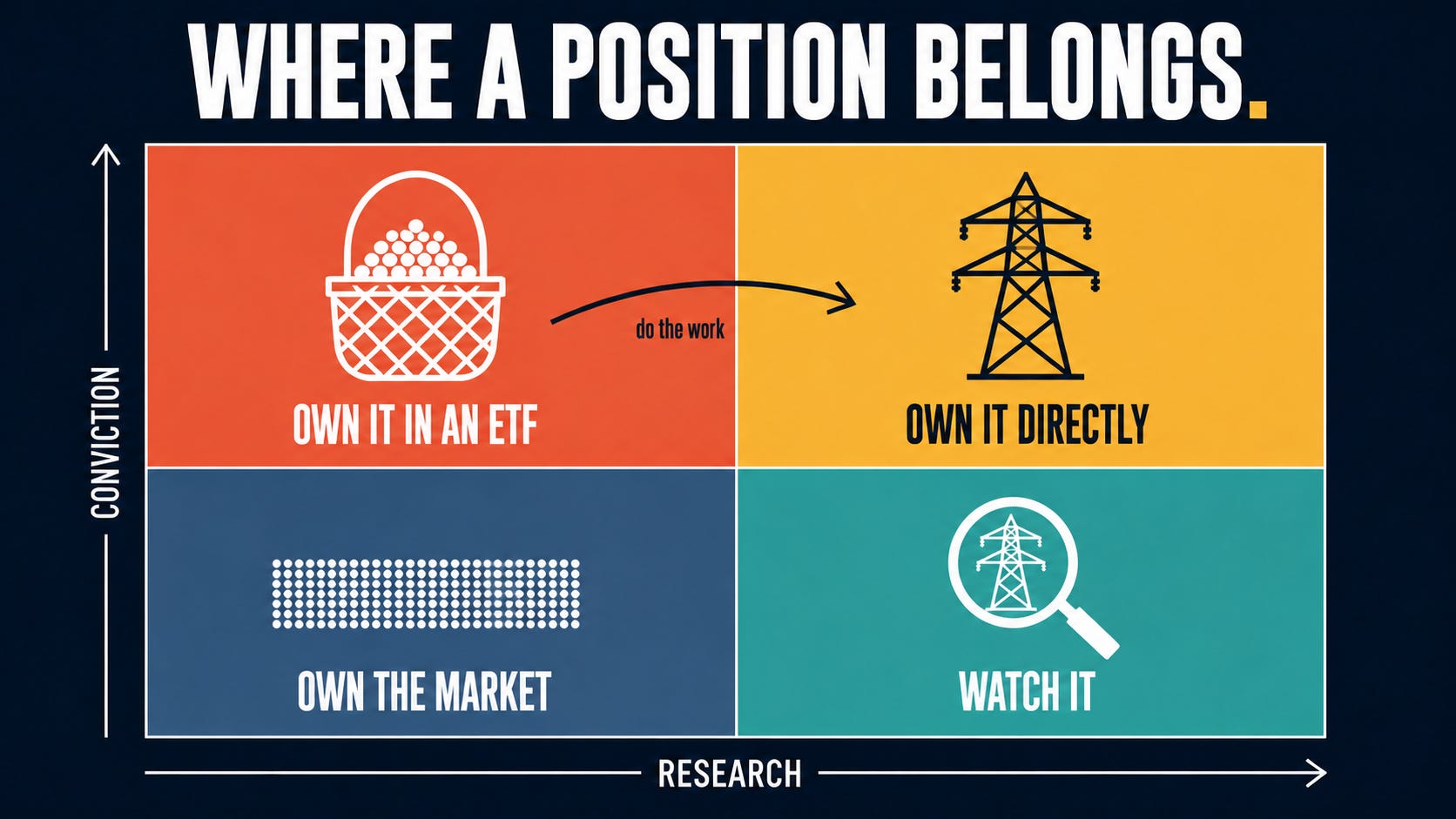
Chart 2 — Where a position belongs. Research and conviction, held directly. Conviction without the research, held in a wrapper. Research without conviction yet, watched. Neither, own the market.
Doing that well means avoiding two mistakes. The first is buying a fund whose name promises your theme and whose holdings deliver a diluted version of it. The second is buying two funds that hold the same thing. Both are easy to make with the funds sold as AI-power infrastructure, and the rest of this section shows where.
The diluted wrapper
I pulled each fund’s daily holdings file and computed how much of it is any of the twelve names. Read the delivered column as the share of your money that reaches the thesis.
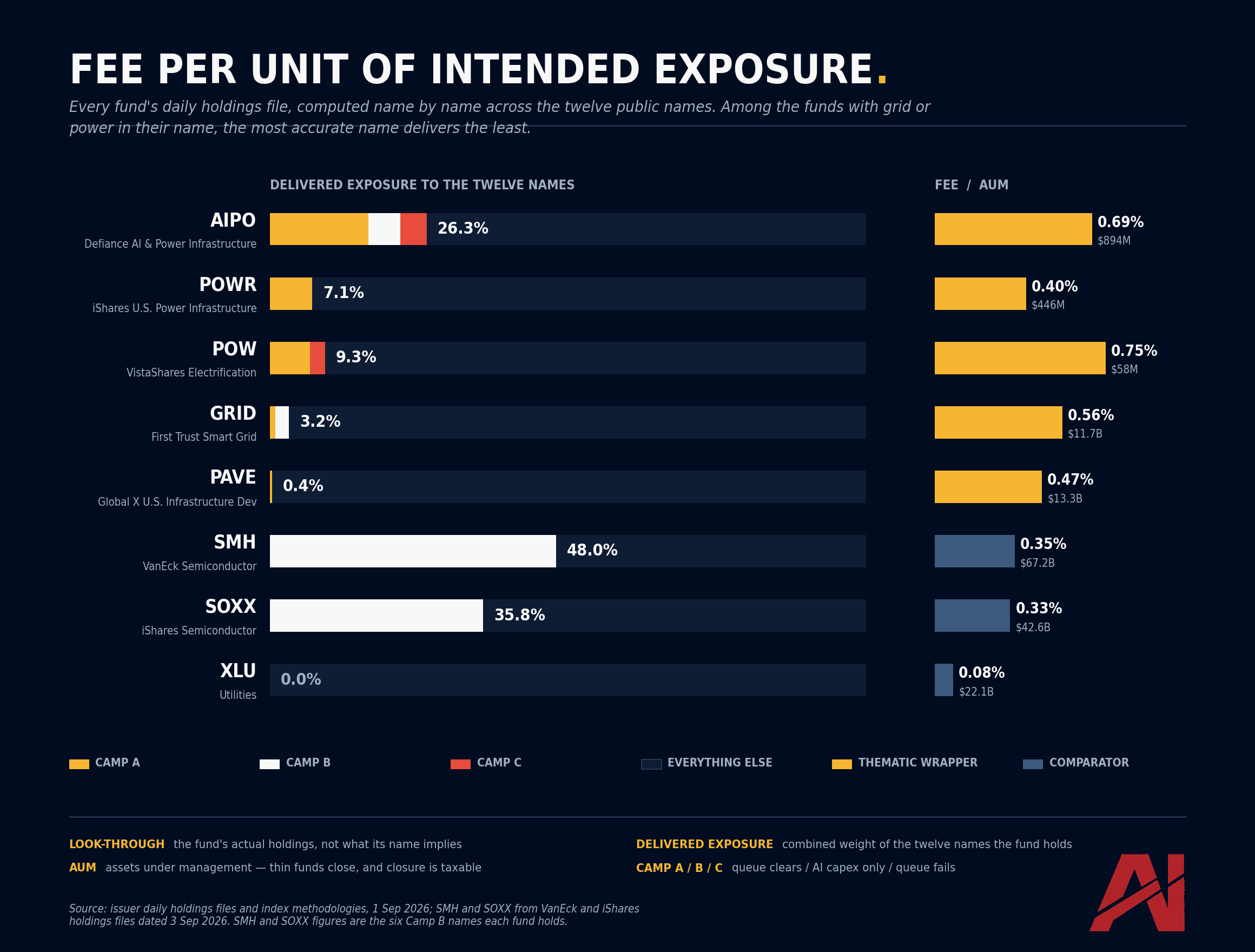
Chart 3 — Delivered exposure and fee, fund by fund, from each issuer’s daily holdings file — the five AI-power wrappers and XLU as of 1 Sep 2026, SMH and SOXX as of 3 Sep 2026. The Camp A, B and C split and AUM are on the chart.
Three of the five that suggest grid exposure have a specific problem beyond dilution.
POWR was an oil fund until October 2025 — it was FILL, the iShares MSCI Global Energy Producers ETF — so everything on its chart before then is an oil fund’s record. It holds two of the twelve names and is roughly half a utilities position.
AIPO comes closest, and is the only fund holding Camp A and Camp C together. In January it amended its universe to include data centers used for digital asset mining, and now holds MARA, RIOT, CleanSpark, IREN, Hut 8 and Core Scientific. Buy it for the grid and you are buying bitcoin miners by amendment.
GRID has the most accurate name of the group and, among the funds with grid or power in their name, delivers the least of the thesis. It holds more NVIDIA than GE Vernova.
The same mistake runs the other way for Camp C. The AI-power wrappers barely hold Bloom — AIPO at 4.4%, POW at 2.6%, the other three at zero. The funds that hold it in size are sold as clean energy. It is the largest holding in Global X Hydrogen at 16.46%, the second-largest in First Trust’s Clean Edge fund at 8.89%, and the third-largest in iShares Global Clean Energy at 7.37%. QCLN also holds Monolithic Power at 8.34%, so it delivers more of the twelve names than any AI-power wrapper except AIPO.
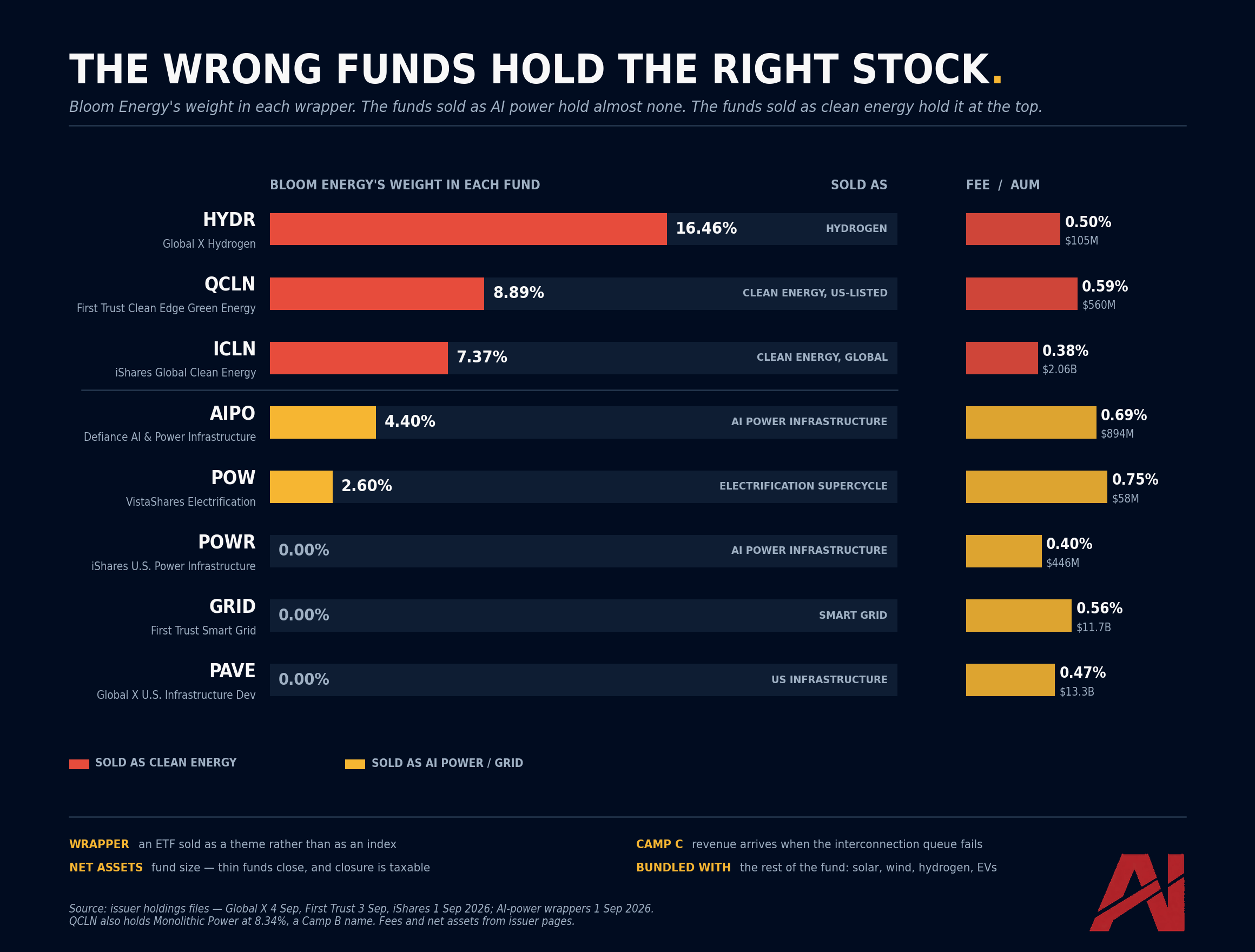
Chart 4 — Bloom Energy’s weight in each wrapper, from issuer holdings files: Global X 4 Sep, First Trust 3 Sep, iShares 1 Sep 2026; AI-power wrappers 1 Sep 2026. Fees and net assets from issuer pages.
The wrapper you would reach for by name is the wrong one, and the wrappers that hold the exposure bundle it with solar, wind, hydrogen, and EVs — a bet on the transition proceeding, which moves for different reasons than a bet on the queue failing. And from September 21, Bloom is scheduled to be in the S&P 500, so anyone holding an S&P 500 index fund will own Camp C without deciding to.
The doubled wrapper
Eleven names sit inside POWR, AIPO and POW at once, the three wrappers built around power rather than infrastructure generally, with Eaton, Quanta and GE Vernova common to every one. GRID and PAVE overlap them less, at 9 to 25%. Hold two of the three and you own roughly a third of the same portfolio twice, and pay two fees for it. The pairs that change a decision:
POWR and XLU overlap 47% — a thematic fund sitting on top of a plain utilities fund, at five times the fee
POWR and AIPO overlap 41%
POWR and POW overlap 37%
AIPO and POW overlap 28%
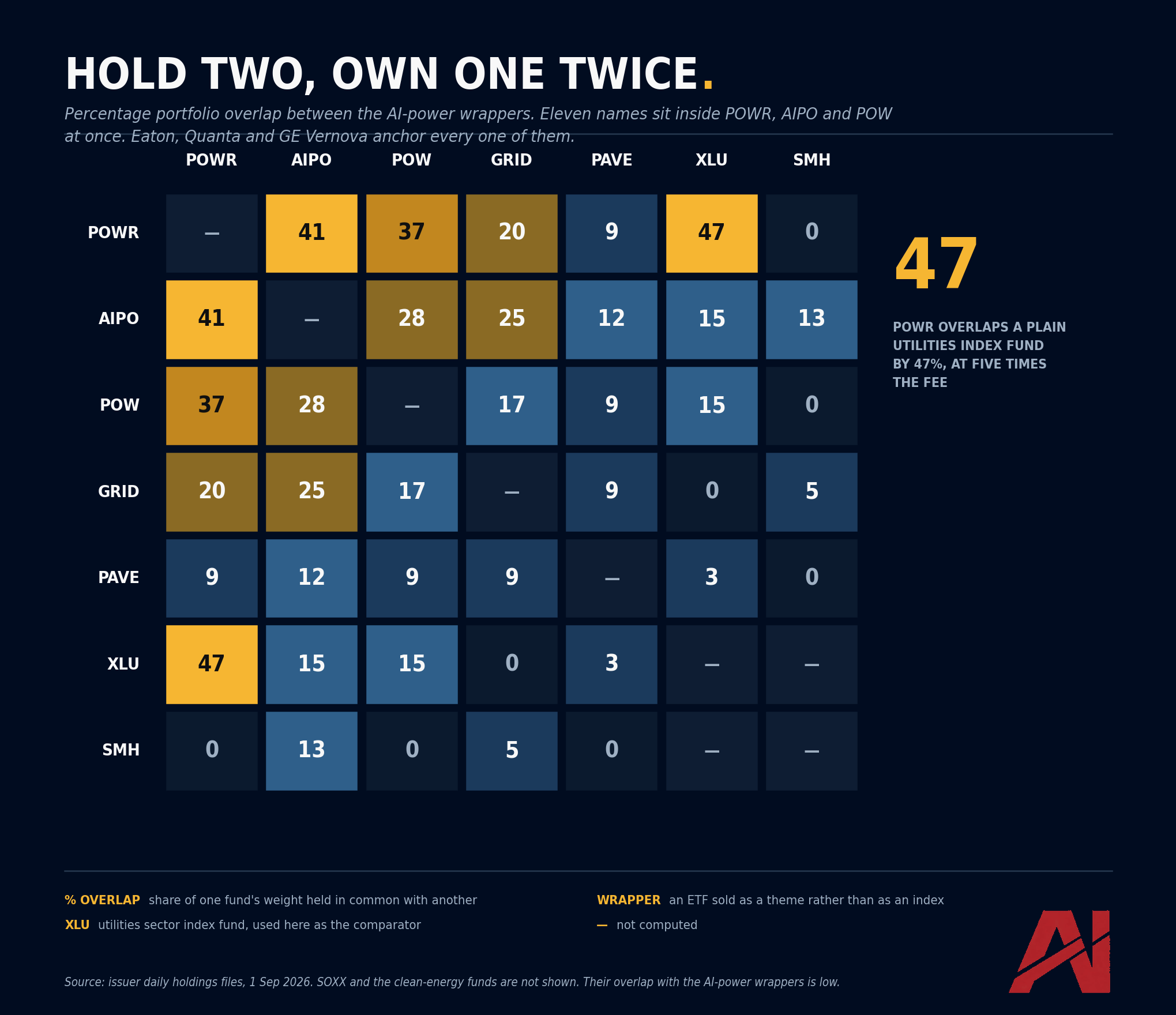
Chart 5 — The overlap grid, from issuer daily holdings files, 1 Sep 2026. SOXX and the clean-energy funds are not shown. Their overlap with the AI-power wrappers is low: Bloom is the only name ICLN and HYDR share with the twelve, and QCLN shares only Bloom and Monolithic Power.
What that leaves
Camp B: SMH or SOXX, at a wrapper’s cost. Camp A and Camp C: no wrapper delivers them. And the private rung, Mainspring Energy and Voya Energy, is not reachable on acceptable terms for a non-institutional investor. Secondaries platforms quote minimums of $5,000 to $100,000 with 2 to 4% taken at entry, and I couldn’t confirm that either company is available on them. The interval funds that carry private sleeves run around 2.90% net with a 5% quarterly repurchase window, and the one I checked holds neither company. Bloom is the instrument that exists.
The problem underneath all of it
Disclosure is growing coarser at the moment it matters most. Marvell collapsed five end markets into two. Lumentum abolished segment reporting. Vertiv dropped backlog from its quarterly releases.
Every quarter, the attribution work behind this edition grows harder to audit, whether somebody else does it or I do. That is the strongest argument for holding names whose disclosure is improving.
What comes next
This edition is an overview of the process I use to underwrite the positions I own or expect to own. From here, the paid edition moves to a monthly cadence with four standing parts:
a review of the direct names, what I own, and what I’m researching
a deep dive on one of those names
a grid update of queue positions and the state of the market
a look behind the four, at the companies that supply them and carry the same constraint one step earlier in the chain
Those supply-chain names are not in this edition. They are coming later this month.
None of this is investment advice, a recommendation, or an offer.