

I opened Moonshot’s pricing page on July 16 expecting the story everyone was already writing. I went in expecting another article about cheaper AI. By the time I closed the pricing page, that wasn’t the article I wanted to write anymore. China ships another frontier model, the price of AI drops another notch, and somewhere in Virginia a data center developer quietly recalculates a spreadsheet. I’ve read that story enough times this year. But when I looked at the numbers, they didn’t match the headline.
Moonshot AI announced Kimi K3 that day — a 2.8-trillion-parameter system, the first open model it says belongs in the three-trillion-parameter class. It was live immediately through Moonshot’s products and API. The full model weights were released on July 27 under Moonshot’s Kimi K3 License.
Within hours, the narrative was familiar: another Chinese lab forcing prices down, more pressure on the American labs trying to earn back the cost of their buildout.
It’s an understandable conclusion. The problem is that we’ve seen this same conclusion after almost every major Chinese release over the past year. Moonshot’s own pricing points somewhere else.
Last week I listed four developments that would make me reconsider the AI infrastructure overbuild. K3 forced me to revisit one of them.
Compared with Moonshot’s previous model, K3 costs about three times more for new input and nearly four times more for output. Even the discounted rate for text the model has already processed doubled. K3 may need fewer tokens to finish a given task — but customers are still paying more to use it. That doesn’t tell us what K3 costs Moonshot to run. It tells us what Moonshot thinks the market will bear.
K3 forced me to separate two questions I’d been treating as one. Is AI getting cheaper to use? Or is it becoming more efficient?
K3 made me rethink the assumption that cheaper AI and more efficient AI are the same thing. The system is far larger than Moonshot’s last release. The technical report shows the model activates only a small fraction of its parameters for each token.
More capability may be arriving without a matching rise in the compute it takes to answer a question.
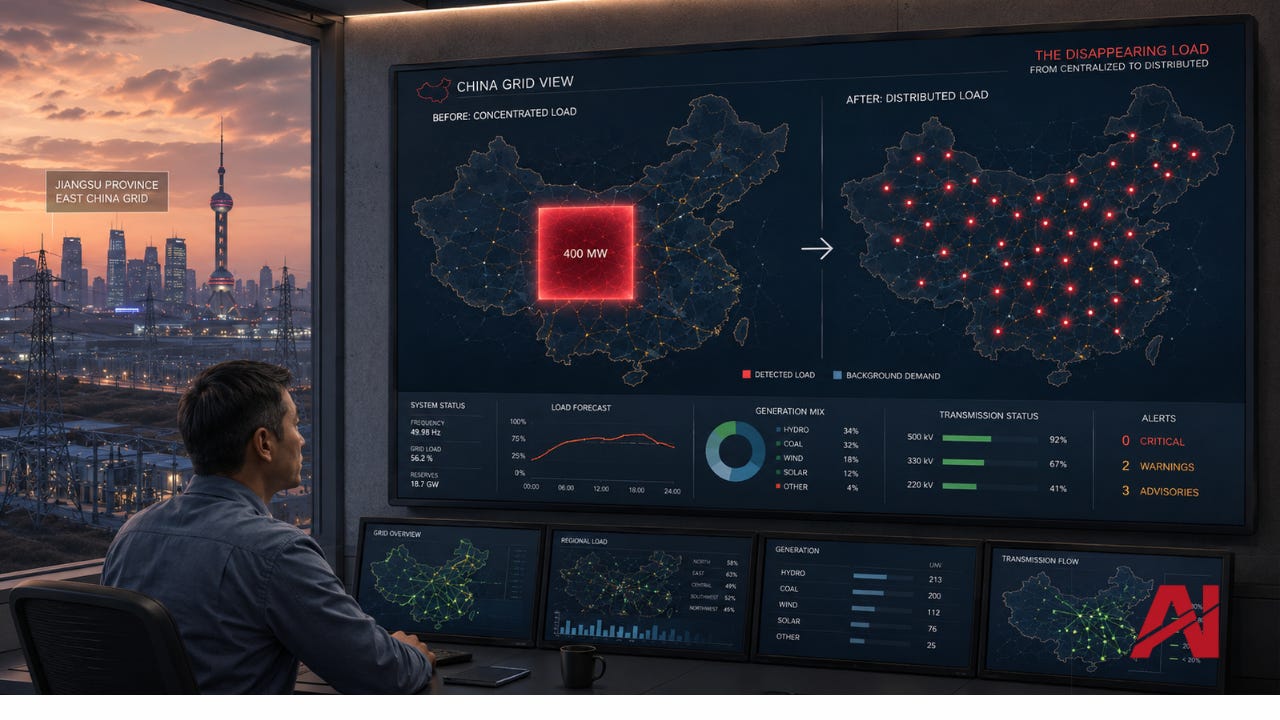
Greater efficiency doesn’t necessarily lower the price customers pay. It may also change where the machines run, how the electricity demand is distributed, and whether that demand appears where the grid planners were expecting it.
The market is watching the price. I think the infrastructure risk is hiding in the design.
In the full edition, I look at why pricing, efficiency, and openness have started to diverge, what that means for infrastructure planning, and why policy decisions may end up shaping AI deployment as much as engineering.
Continue with the full analysis as a paid subscriber.
