

Edition 27, 29 September 2026. Prices and returns are at the 25 September close unless a date is given.
For three editions I’ve worked at the level of single stocks: the camps, then Bloom, then the order book that went up while the stocks went down.
This week I want to step back and look at the grid itself, because the most important thing that happened to it this year isn’t clear from the SEC filings.
It happened in the politics of who pays.
Here’s the short version. In 2026, the market took money away from the companies that sell power into the grid and handed it to the companies that help data centers go around it. That’s what the record shows, and it lines up almost date for date with a change in the rules.
I am not going to try to speak to all seven ISOs. ERCOT and PJM are the easiest examples to make the point.
The scoreboard
Take four groups and one benchmark, and measure 2026 from the last close of 2025 to 25 September.
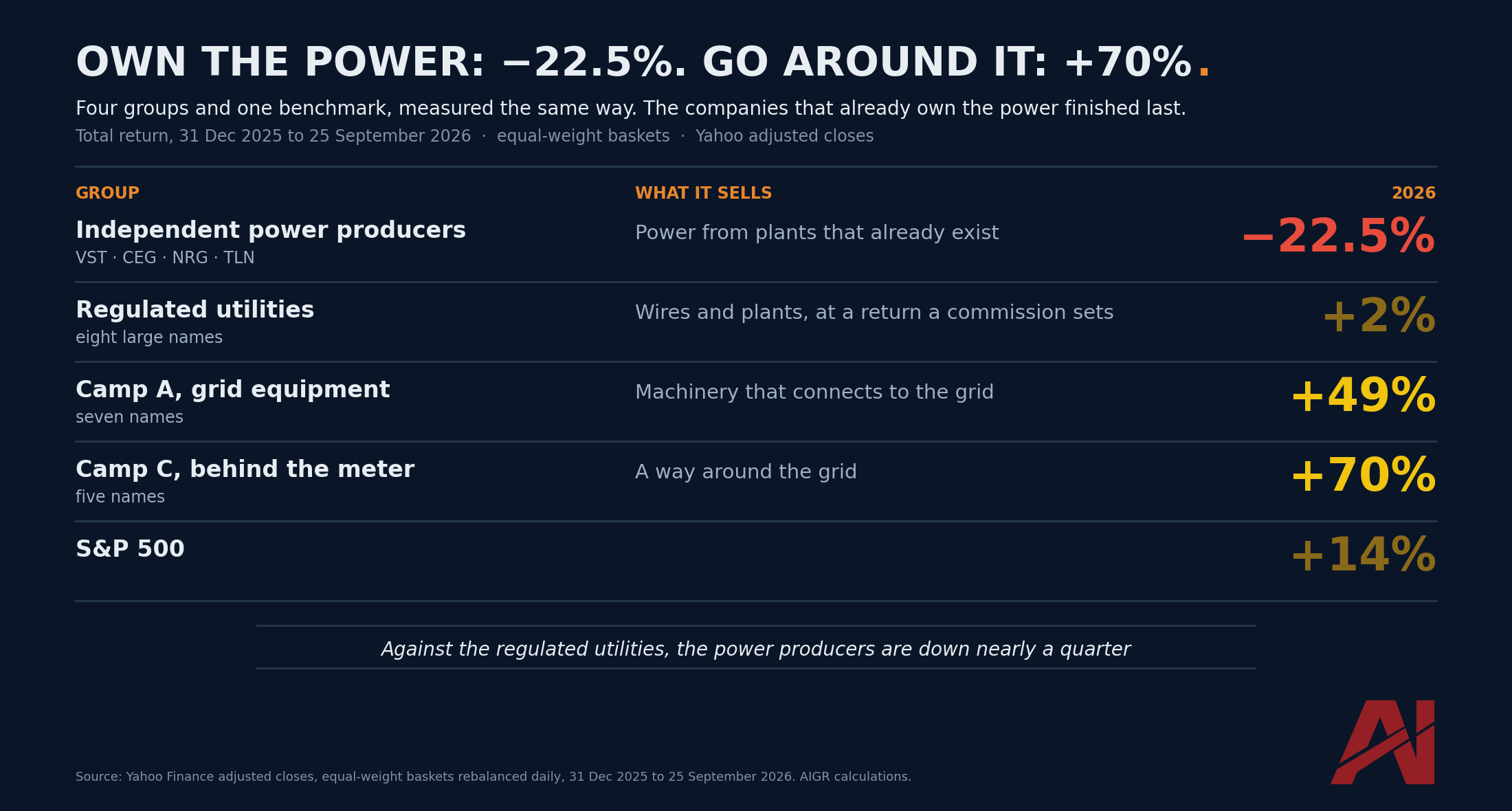
Inside the first row, NRG is down 36%, Constellation 25%, Talen 19% and Vistra 14%. Compared with the regulated utilities, the producers as a group are down 24%.
The companies that already own the power lost ground. The companies that build the machinery to move the power through the grid made money. And the companies that let a data center bypass the grid to make its own power made the most.
Why would the owners of the scarcest thing on the grid, working power plants in a region that’s short of them, finish last?
Because in 2026 the ratepayer found its lobbying voice, connected with politicians, and the lobby’s first target was the price of the scarcity those power plants produce.
The ratepayer turn
Start with the price that sets everything else in the largest grid in the country.
PJM, the operator that runs the grid from Chicago to Virginia, buys capacity a few years ahead in an auction. Capacity is a promise to be available when the grid needs it, and it’s the line where scarcity turns into money for the owner of an existing plant.
The rules changed in a sequence through the year, and the July auction sits in the middle of it.
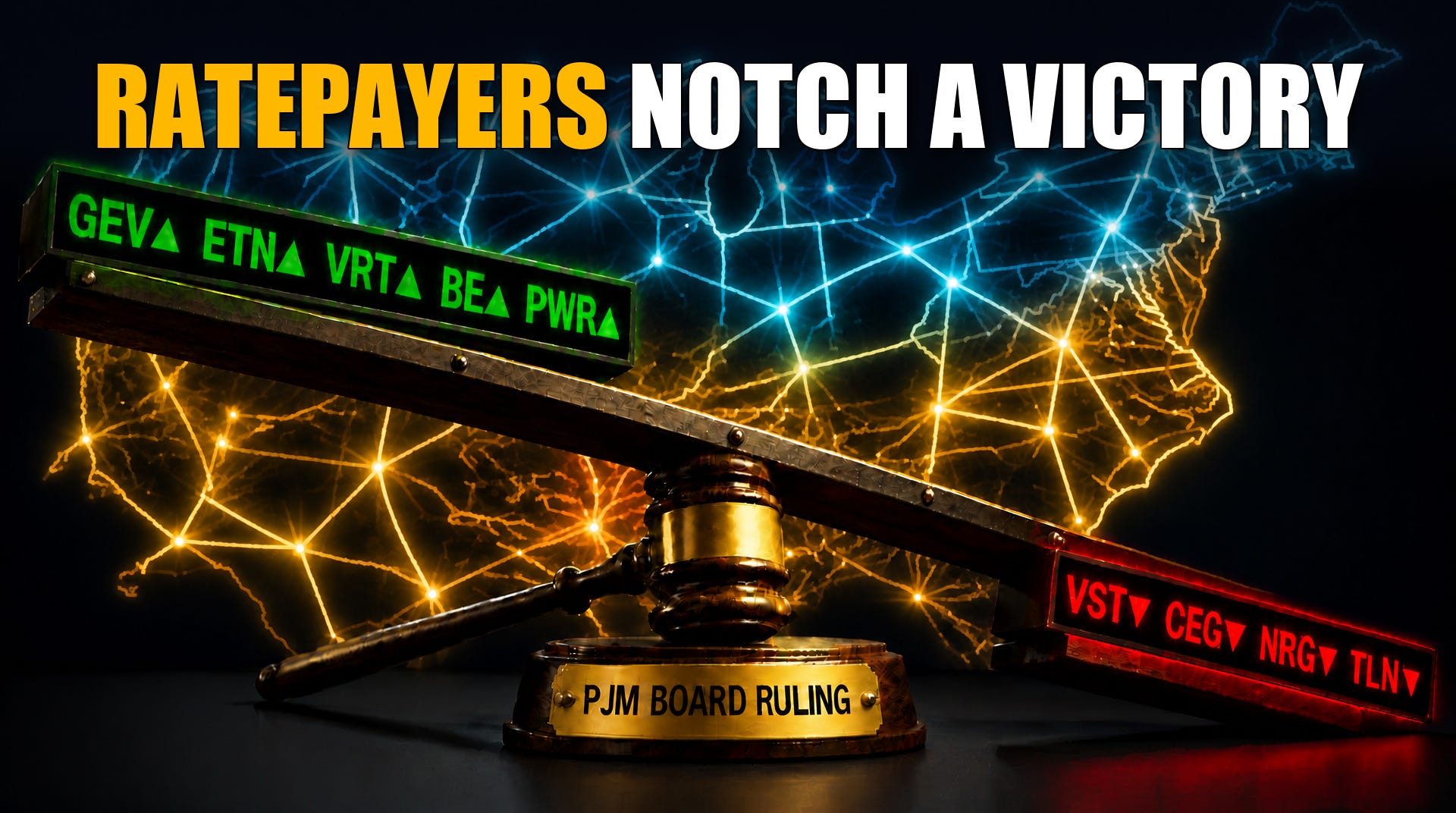
16 January. The White House and the governors of all 13 PJM states issued a joint statement of principles. They asked for an emergency auction for new plants, 15-year contracts paid by the data centers whether they use the power or not, and an extension of the price collar. That day the four power producers fell between 4% and 11%, while Bloom rose 7%, GE Vernova 6% and Eaton 3%.
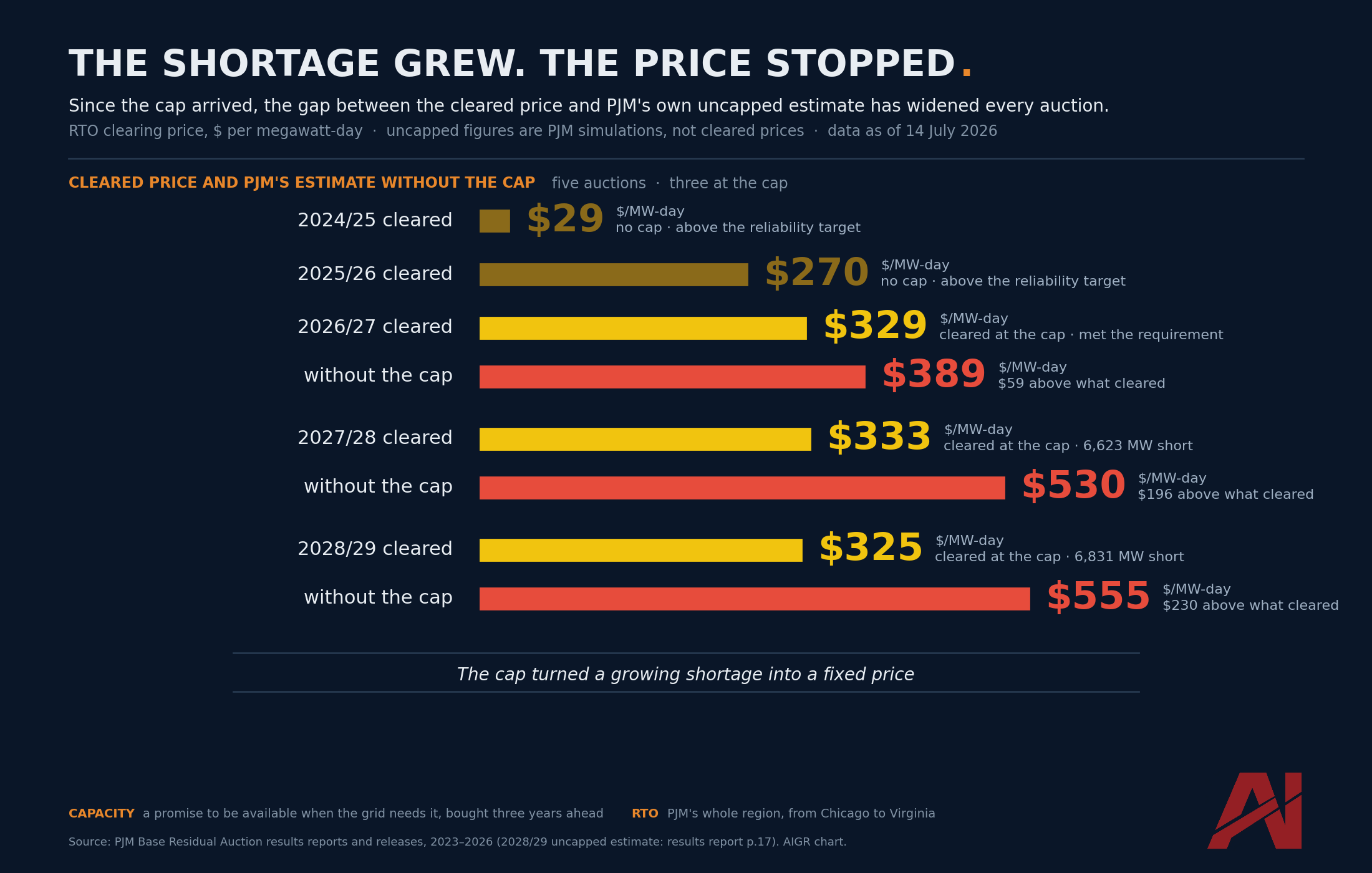
28 April. FERC approved PJM’s request to keep the price collar for the next two auctions: a ceiling of about $325 per megawatt-day and a floor of $175. The ceiling remains in place through the auction that closes in December.
Through the spring, the states moved too. Florida, Oklahoma, Tennessee and South Dakota all passed large-load cost rules between March and May.
14 July. The auction for the 2028/29 delivery year cleared at $325, the collar’s ceiling. It came up 6,831 megawatts short of what PJM says it needs, the second auction in a row in which the whole region fell short. The two are the first in PJM’s history. PJM’s own simulation without the collar put the price at about $555.
So the shortage grew, and the price was capped.
27 July. The PJM Board told its staff to “exclude any incremental new Large Loads” from the demand used in future capacity auctions, starting with 2029/30. New data centers return to that demand only when they bring their own new supply. Those without enough capacity by 1 June 2027 go into an interim service that can curtail them first. The board cut the fat tail of data center load from the distribution to remove distortion and reduce the risk of large loads being socialized to ratepayers.
16 September. The House passed the Ratepayer Protection Act, H.R. 9340, by 417 votes to 3. It asks every state to consider rules that make data centers of 100 megawatts or more pay the full incremental cost of the grid they need, post financial security, and pay to leave early.
21 September. California signed seven data-center laws. Two make data-center tariffs mandatory: one for loads of 25 megawatts or more, with generation costs recovered over at least 10 years, and one with an interconnection tariff by 2028 and a 10-year exit fee.
Each of these moves means the same three things for the owner of an existing plant. You won’t be paid the scarcity price. The newcomer will pay for the new supply. And whoever caused the gap will pay the bill.
Here’s the detail that tells you how settled this has become. On 17 September the Senate blocked the House bill on a single objection, then blocked the Democratic alternative on the next one.
The argument wasn’t whether to protect the ratepayer.
It was which ratepayer protection would become law.
In the paid section: what the ratepayer bought and who paid for it, in dollars. How the rules moved the money. The price evidence, stock by stock. The one company that took almost all of the go-around premium, and where my own reading of it was wrong. And what it means for the one position I hold in this trade.
