

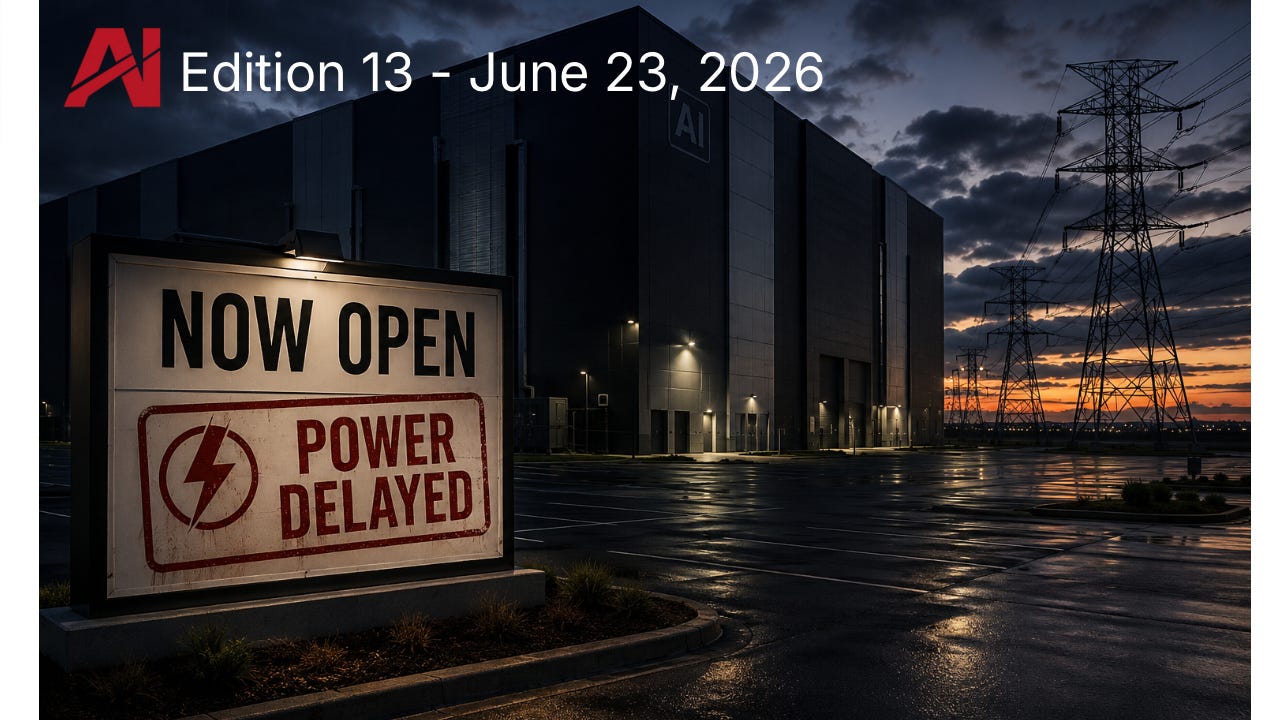
Hundreds of millions of dollars were committed.
The site was selected.
The permits were approved.
Customers were ready.
The project still couldn’t turn on.
Not because financing disappeared.
Not because demand dried up.
Because the electricity never arrived.
If you invest in AI infrastructure, utilities, energy, or data centers, this isn’t an isolated case. It’s an early indication of how the economics of AI infrastructure are beginning to change.
For the past two years, investors have understandably focused on hyperscaler capital spending, GPU demand, and multi-billion-dollar campus announcements. Those numbers are easy to measure and easy to compare.
The harder question is whether those projects will receive power when they need it.
That question is increasingly important because every additional month waiting for electricity changes construction schedules, financing costs, projected returns, and competitive positioning. Building a data center and energizing one are no longer the same challenge.
This week’s research begins with a project in Santa Clara that appeared to have every advantage.
The land was secured.
The financing was complete.
The permits were approved.
A power agreement had already been signed.
Yet the project remained dark.
What happened there reveals something much larger than a single delayed development.
It exposes a structural constraint that is beginning to shape where AI infrastructure can be built.
After tracing the Santa Clara case, I found the same pattern appearing across multiple U.S. power markets. The bottleneck isn’t disappearing. It’s moving into parts of the system that receive very little attention but increasingly determine whether a project becomes an operating asset or an expensive stranded investment.
In this week’s report, we examine:
Why more and more projects fail after the press release rather than before it.
Why interconnection queues are only the first stage of a much longer timeline.
Why even locating beside an existing nuclear plant doesn’t guarantee access to power.
Why the same data center can become operational in one market while remaining stalled for years in another.
Most coverage of AI infrastructure follows the announcements.
AI Grid Report follows the physical system that determines whether those announcements ever become reality.
Every week I publish original research on power markets, transmission, interconnection, utility planning, and the infrastructure constraints that shape capital allocation across the U.S. energy system.
If your work depends on understanding where AI investment can actually become operating infrastructure—not simply where it is announced—I think you’ll find value in becoming a subscriber.
For paid subscribers: the full report begins below, including the complete Santa Clara case study, supporting figures, and the analytical framework I now use to evaluate whether an AI project is likely to receive power on schedule.
