


Everyone assumes the AI infrastructure race will be won by the same handful of regions.
ERCOT.
PJM.
Maybe MISO.
Those are the regions attracting the headlines, the investment dollars, and the bulk of developer attention.
But attention and opportunity are rarely the same thing.
Over the past several weeks I’ve been comparing the smaller U.S. grid regions through a simple lens:
If you needed a large amount of power for a new AI project, which grid would give you the shortest credible path to energization?
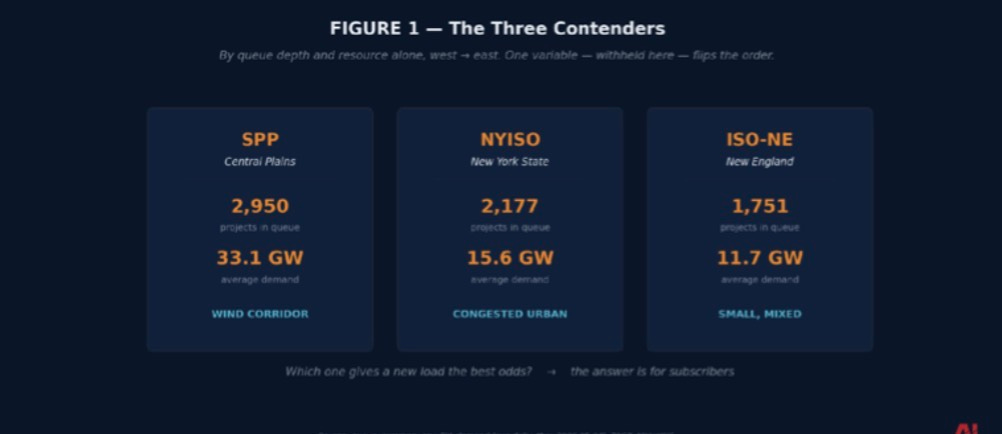
Figure 1 — The Three Contenders
On paper, the outcome looks obvious.
One has enormous renewable resources.
Another sits next to one of the largest concentrations of demand in North America.
The third is smaller, quieter, and rarely appears on anyone’s shortlist.
If you ranked them by reputation alone, you’d probably put that third contender last.
The data says otherwise.
New to The AI Grid Report?
The AI Grid Report helps investors, developers, bankers, and energy executives understand the forces shaping AI infrastructure, power markets, and capital allocation.
Each week we combine proprietary research, grid analysis, and market intelligence to answer a simple question:
Where is the next infrastructure opportunity emerging—and what are most people missing?
If you’re interested in the intersection of AI, energy, and investment, subscribe below to receive future issues.
Paid subscribers can continue below for the full analysis, including:
The complete comparison of SPP, NYISO, and ISO-NE
The demand-pressure framework driving the rankings
The full Speed-to-Power analysis
Our conclusion on which overlooked grid offers the strongest path to new AI infrastructure
