

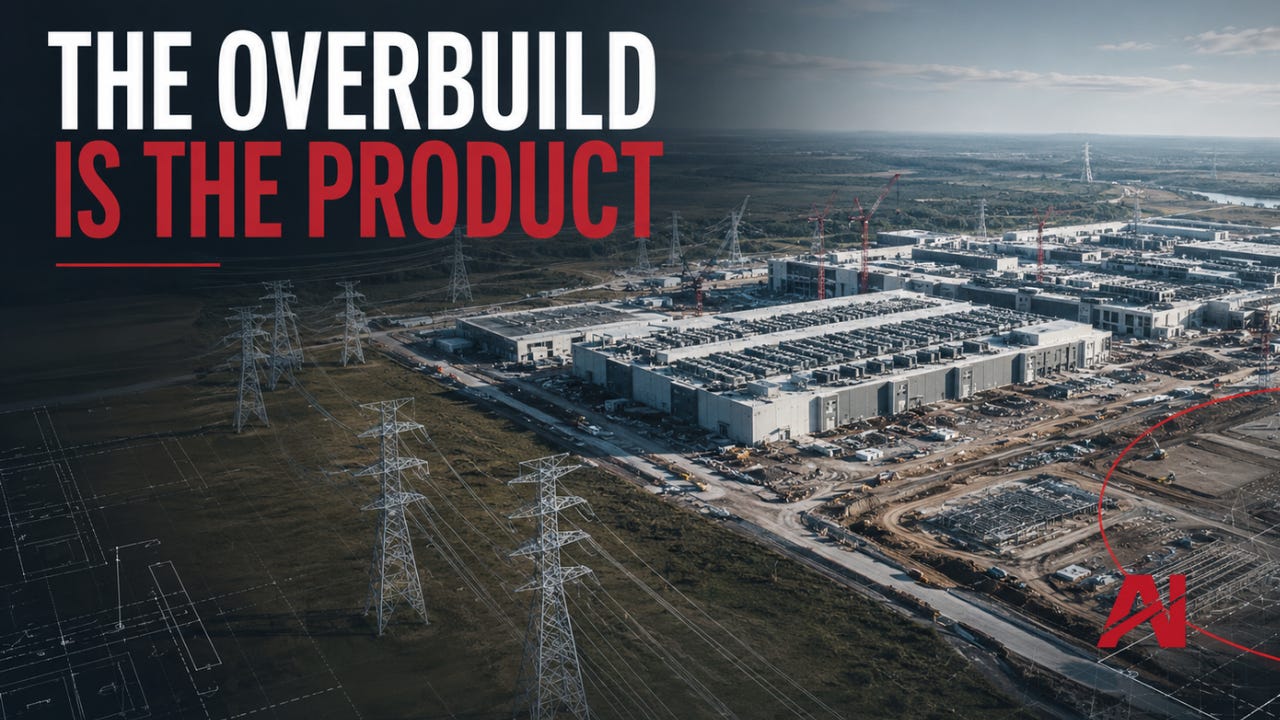
There’s a number I can’t stop turning over. ERCOT’s large-load queue — the list of companies asking Texas for power — is sitting at roughly 438 gigawatts. About 9 of those gigawatts have actually been approved to energize. Less than 4 are running.
Think about that for a second. That’s a claim staked on a physical system, made by people who have no idea yet which of their projects will get financed, built, or ever switched on.
The easy explanation is speculation — developers padding requests because queue position is worth something, hyperscalers keeping every door open, utilities planning for demand that might be a mirage. It’s all true; but I just don’t think it’s the whole story.
Because you can see the same thing earlier than the utility filing. Long before anyone calls ERCOT.
When an AI system hits a wall — a memory bottleneck, a latency problem, whatever — the industry’s reflex is rarely to slow down and solve it. The reflex is to add hardware: brute force. More chips. More racks. More power. The campus grows to fit the workaround, not the problem. And when nobody’s sure what the future looks like, you build for every version of it at once — which is a very reasonable thing for any one team to do, and a strange thing to watch happen a hundred times in parallel.
I’ve started calling this unearned scale. Not because big is automatically bad — some workloads genuinely need everything they’re asking for. Unearned scale is the capacity you add because adding capacity is easier than fixing the problem that made it necessary in the first place.
And here’s the part that should bother you more than the ERCOT number itself: none of this stays contained inside the data center. A compute decision quietly becomes a rack requirement. The rack requirement becomes a power request. The power request becomes a substation, a transmission line, a fight over water rights, and — eventually — an argument about whose electric bill absorbs the cost. By the time it reaches the grid, the original decision that caused all of it is nearly invisible. Nobody in that fight even remembers where it started.
We’ve spent a few years treating scale itself as proof of progress — bigger model, bigger campus, bigger check written. I keep asking a different question: what happens the moment the systems underneath can’t absorb the cost of all that bloat?
That’s the overbuild story. The queue is just the place where it finally becomes visible.
The paid edition traces where this begins, how it adds up, and which projects are getting the most exposed as the grid, the public, and capital markets start moving the goalposts. Subscribe to keep reading.
