

Across the seven US interconnection queues we track, 14,856 projects have withdrawn.
That is approximately 2,093 GW of proposed generation — more than twice the entire installed capacity of the United States — walked away.
No storm. No policy reversal. No single cause.
Projects simply did not make it out of the queue.
The headline queue numbers suggest abundance.
The withdrawal numbers tell a different story.
Most models still treat the headline number as real.
From Texas to Everywhere Else
Last week, we looked at Texas.
ERCOT clears its queue. 0% withdrawal rate. Every project that enters gets through.
That is the exception. Everywhere else, the queue behaves more like a sieve.
→ CAISO: 75.6% withdrawn
→ NYISO: 81.2% withdrawn
→ ISONE: 75.3% withdrawn
→ PJM: 67.4% withdrawn
→ SPP: 64.0% withdrawn
→ MISO: 54.5% withdrawn
The median project in six of seven tracked regions never becomes a project.
The Spread Is The Story
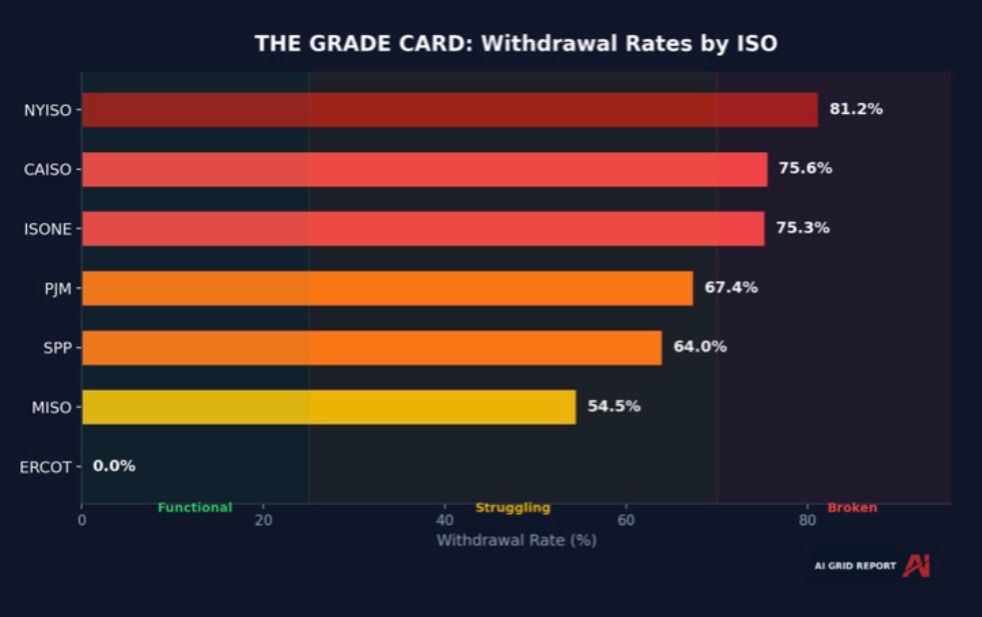
0% in Texas and 81% in New York. That spread is not random.
It is a grade on process design — study timelines, fee structures, cost allocation rules, speculation filters.
The regions with the longest studies and the most ambiguous cost-allocation rules have the highest withdrawal rates.
The regions with faster processes and clearer rules have lower ones.
Withdrawal is not a supply problem; it is a process outcome. Most commentary still treats it as a supply problem.
What Withdrawal Measures
A withdrawal is not a cancelled project.
It is a completed study, an interconnection agreement negotiation, consultant fees paid, sometimes years of developer time, and then the developer walks away.
The costs are already sunk.
The grid study is already done.
The planners already slotted the project into their load-flow models.
When a project is withdrawn, all that work is unwound.
It is the most expensive form of queue churn.
The Open Question
If two-thirds of the projects in PJM’s queue never get built, why is the queue still growing?
The answer is structural—and uncomfortable.
Developers are not filing because they expect to build.
They are filing to preserve optionality — a queue slot, a study result, a position in the stack — while they watch the market.
The queue has become an options market on future interconnection rights.
Most of those options expire worthless.
The open question is whether the market should allow that to continue.
In This Week’s Edition
This week’s edition breaks down:
• why the spread from 0% to 81% is a grade on process design, not supply
• which generation types disproportionately die in the queue — and what that says about the energy transition
• how headline queue GW overstates the actual pipeline by a factor of three
• what a withdrawal-adjusted queue looks like for AI infrastructure planning
The full Constraint Index shows which regions have functional pipelines — and which ones are running on paper volume.
Continue reading
